
THE POST-ALGORITHM WORLD (YEAH, I KNOW, IT’S MY FAVOURITE WORD)
The user is dead.
Not literally. The body still clicks, scrolls, buys shoes at midnight, rage-reads LinkedIn posts from men with ring lights and fake calm. But the old idea of the “user,” that tidy little software citizen who pressed buttons and waited for the machine to obey, has been gutted. We are no longer users. We are inhabitants. We live inside the algorithm now. It wraps around the room like humidity. It decides what gets seen, what gets buried, what earns a pulse, what dies in the feed without even a decent funeral.
For decades, the professional services industry staggered around under a comfortable delusion. Software was a tool. A passive thing. A hammer with a login screen. It sat there and waited for the blessed human to give it orders. Agencies built entire operating models on that fantasy. The agency was a factory of operators, rows of human engines processing client demands, polishing decks, resizing assets, writing copy nobody loved but everyone approved because the deadline had developed teeth.
Growth meant more seats. More bodies. More hours. More warm brains strapped to the conveyor belt. That world is over. Not “evolving.” Not “being disrupted.” Over. Dead behind the eyes.
We have entered the Post-Algorithm World, where artificial intelligence is not another item in the tech stack. It is the stack’s weather, its bloodstream, its godforsaken atmosphere. The agency does not use AI like it uses a scheduling tool. The agency now exists inside an algorithmic environment, whether it admits it or keeps pretending this is just another software adoption curve with a cute training session and a branded PDF.
Research from 2025 makes the point with almost cruel simplicity: like the fish that discovers water last, the modern agency is often the final idiot in the room to realize the medium of its existence has changed. The algorithm is no longer outside the business. It is the business terrain. The old split between “platform” and “user” is collapsing into mush. Human intelligence and machine capability are no longer cleanly separated. They are tangled together in the wires, the workflow, the decision, the recommendation, the invoice.
The old Command and Control model of human-computer interaction is dissolving. In its place comes Agentic Collaboration, a stranger and more volatile arrangement where technology can reason, plan, sequence, and execute complex workflows without waiting for a human manager to hover over it with a coffee breath and a status check.
The strategic burden has shifted from manual operation to organizational orchestration. That sounds tidy. It is not tidy. It is a nasty little regime change.
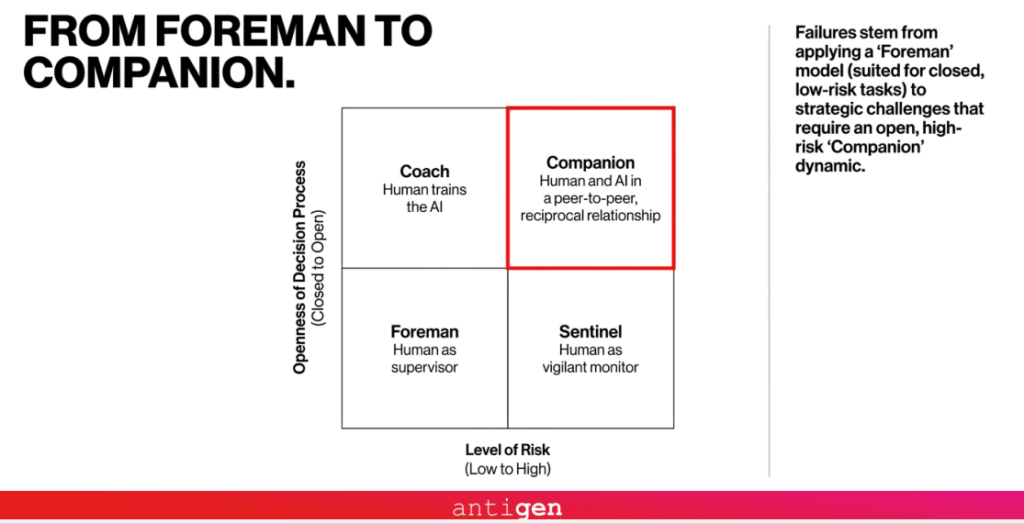
In the old paradigm, the agency was the bottleneck. Human time was the choke point. You only had so many hours, so many people, so many late nights, so many freelancers pretending they were fine. The machine has now smashed the bottleneck, and most agencies are still standing there with their clipboards, blinking at the sudden absence of friction like cavemen watching the elevator doors open. This transition is moving at a pace that mocks history. Industry benchmarks indicate that Large Language Model capabilities are doubling every seven months, three times faster than Moore’s Law. That is not a trend line. That is a Technological Tsunami with a clean interface and a venture-backed grin. The old Foreman model of management cannot survive this. You cannot supervise the algorithm like it is a junior strategist who missed the morning standup. The relationship has to become peer-to-peer, reciprocal, companion-like, and deeply irritating to anyone whose authority depends on controlling the buttons.
Survival now rewards the architect over the operator. The current agency crisis is not a temporary downturn. It is not some cyclical correction where everyone tightens the belt, mutters about procurement, and waits for the good times to crawl back under the door. This is a fundamental remaking of persuasion, strategy, creativity, pricing, labor, and value itself. Ambient computing is dissolving the digital boundary. The agency cannot be patched. It has to be rebuilt from the studs. This report is an autopsy. We are cutting into the industry’s soft gray belly to see what killed the old model and what, if anything, can still be saved.
The data-backed reality is the Productivity Paradox. The machine is running at light speed. The organization is still stuck in the mud of legacy process, waving a scope of work like a religious pamphlet in a flood.
The Productivity Paradox: Why Speed is a Pricing Mirage
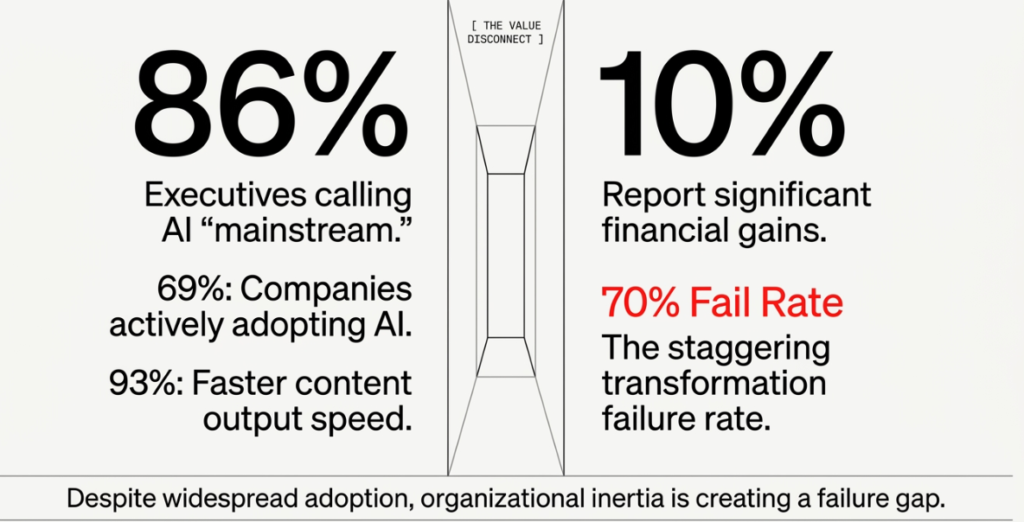
The most dangerous hallucination in the modern agency is the belief that efficiency means efficacy. It does not. Efficiency is the little drug everyone wants because it feels clean. Faster drafts. Faster edits. Faster variants. Faster everything. The dashboards glow. The executives nod. Somewhere, a transformation officer says “unlock” for the seventeenth time in one meeting and nobody throws a chair. But there is a widening gap between efficiency and actual value, and that gap is starting to look like a canyon full of unpaid retainers and dead strategy decks. Analytical data shows the disconnect in bright ugly numbers: artificial intelligence has driven output speed up by 93% and contributed to an 81% boost in brand awareness across early adopters, yet only 10% of organizations report significant financial gains.
That is the Productivity Paradox. The industry is generating more, faster, louder, cheaper, and somehow still not getting paid properly for it. The 70% transformation failure rate is not mysterious. Leadership keeps trying to bolt a warp-speed engine onto a horse-drawn carriage. The beast kicks, the wheels catch fire, and everyone calls it innovation because there is a steering committee.
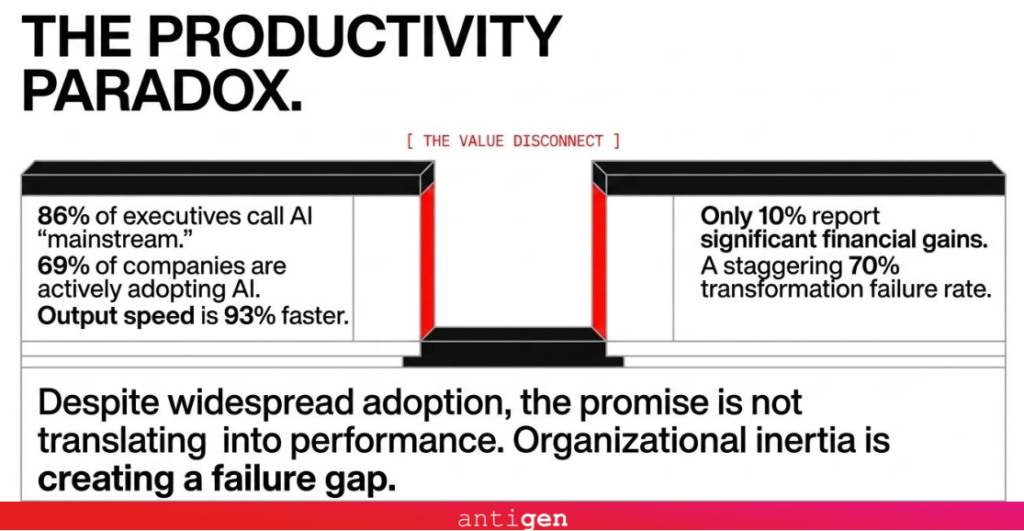
Faster output does not automatically create higher value. In an era of infinite generation, speed can just accelerate the race to the bottom. The machine makes the asset faster. The market notices. The market adjusts. The price collapses. Congratulations, you optimized your way into poverty. The strategic “So What?” is immediate and brutal. If an agency can produce content 93% faster, the unit price of that content starts tumbling toward zero. In an environment where assets are generated in seconds, volume-based growth becomes a pricing mirage. It looks like water until you reach it. Then it is just hot sand and a client asking why this costs so much.
The broader market is already sending smoke signals. Data from Q1 2025 shows average volume growth for 11 CPG giants turned negative, falling to -1.0%. Research from 2024 indicates that 95% of retail sales value growth in developed markets came from price increases rather than selling more products. That matters for agencies because selling assets in a high-speed environment is a recipe for bankruptcy wearing a nice shirt. When output is commoditized by the machine, competing on volume is competing on a metric AI already owns. It won that fight before the agency finished naming the task force. The Volume Crisis is real. Agencies become its first casualty if they refuse to decouple revenue from artifact production. The deeper rot is organizational inertia. Agencies spent a century optimizing for scarcity. Scarcity of talent. Scarcity of time. Scarcity of media space. The whole operating model was built around the idea that production capacity was precious. Now the industry has stumbled into infinite generation, and the old processes are still clanking along, measuring the wrong things, rewarding the wrong behaviors, worshipping the wrong gods.
The strategic failure is the assumption that the goal is to do the same things faster. That assumption belongs in a shallow grave. The same things no longer hold the same value. Using AI to flood the market with more of the same is not transformation. It is spam with better typography. It is noise in a nicer jacket. It is the agency participating in its own margin collapse while calling the process acceleration.
The machine is fast. The workflow is sick. Speed applied to sickness does not heal it. It spreads the infection.
THE “AUTOMATED MESS”: STRATEGY AS A FAILED PROCESS
If you Automate Crap, you get Automated Crap
The cardinal sin of agency leadership in this era is believing technology can fix a broken culture.
It cannot. No model, no platform, no shiny agentic workflow with a tasteful landing page can rescue a rotten strategic process. Code does not redeem confusion. Automation does not baptize dysfunction. The old maxim still stands there, chewing a toothpick and looking bored: if you automate a mess, you get an automated mess. The industry is now littered with wreckage from firms that threw generic models at inefficient workflows without scaffolding. No structured prompts. No ethical guardrails. No contextual constraints. No real design of the human-machine relationship. Just a feverish little mandate from leadership to “use AI more,” as if adoption itself were a strategy.
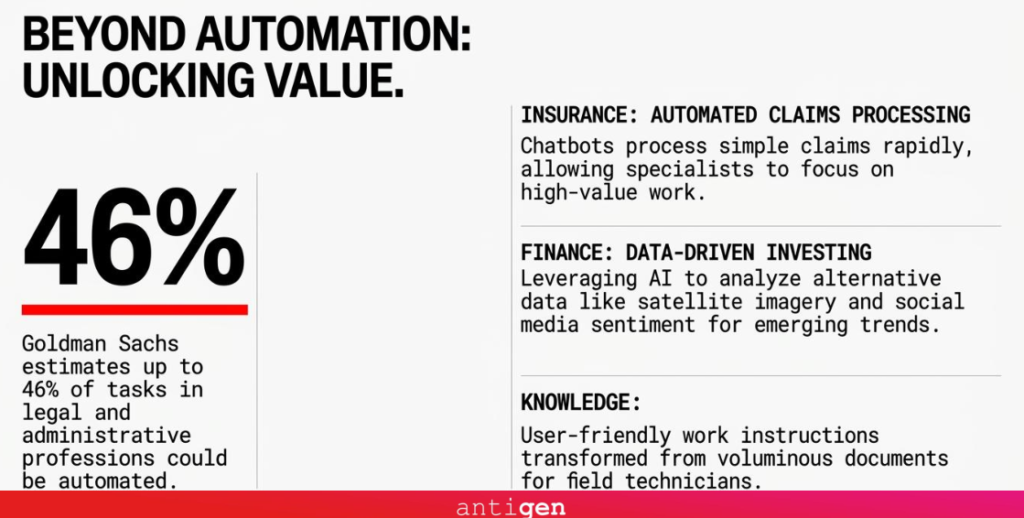
We have seen the results. A legal professional relying on AI-fabricated citations. Security leaks from uploaded source code. Self-generated news polls slipping out of control. These are not failures of technology in the pure sense. They are failures of human oversight, strategic discipline, and organizational design. AI does not remove the need for judgment. It exposes the absence of it.
Without structure, automation becomes a liability. A fast liability. A liability with autocomplete.
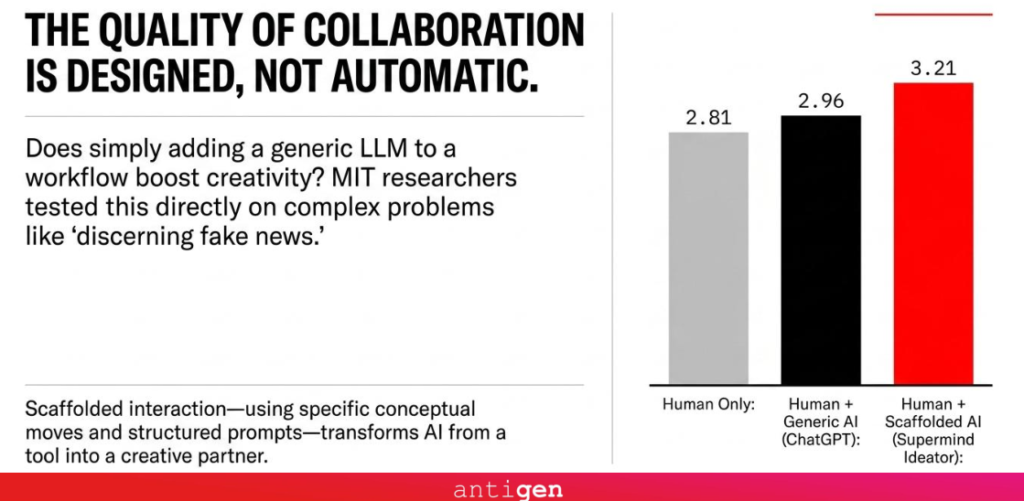
Research indicates that simply adding a generic AI tool to a workflow does not meaningfully boost creativity. Studies involving complex problems such as discerning fake news show that humans using scaffolded AI, with specific conceptual moves and structured prompts, perform significantly better than those using generic AI or working alone. This should make agency leaders sweat a little. Most agencies still treat AI as a black box. They type into it like pilgrims dropping coins into a haunted fountain, then act shocked when the output has the nutritional value of damp cardboard. The winners will design the collaboration. They will build specialized interfaces, structured moves, and disciplined loops that turn the machine from a basic tool into a creative teammate. Without that intentional design, automation corrodes trust and caves in quality control. Without a robust data foundation and regulatory adaptation, agencies are flying blind into a liability storm, grinning because the cockpit has a new dashboard.
Then comes the People Problem, and this is where the whole thing gets especially grim. Digital Taylorism has crawled back out of the grave. Frederick Taylor used a stopwatch to break manual labor into measurable chunks. Today’s agency leaders use Bossware and AI-driven surveillance to track cognitive labor with a granularity that strips the oxygen out of the room. The old factory floor has become the Slack workspace. The stopwatch has become the productivity score. The foreman has become software. Data shows that 60% of employees fear replacement by AI. That fear does not create innovation. It creates passive resistance. It creates silence. It creates little survival rituals, people hoarding knowledge, hiding process, smiling on camera while quietly building a moat around their job.
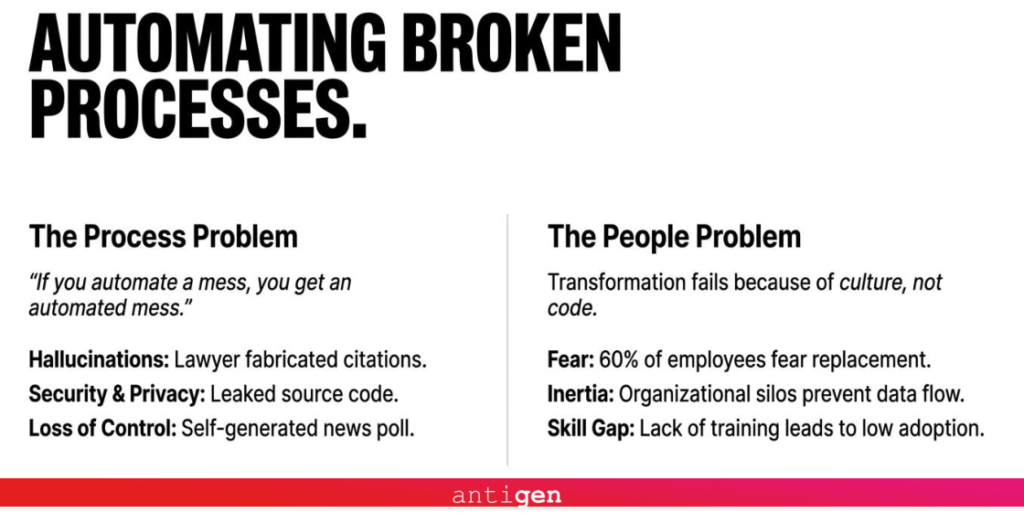
This cultural inertia is leadership’s fault. Too many agency leaders have treated AI as a headcount reduction tool rather than a capability augmenter. They looked at the machine and saw a cheaper worker. They should have seen a new form of leverage. By failing to move teams from a Foreman mindset to a Companion mindset, agencies have created hyper-visible, low-trust workforces. Everyone can be watched. Nobody feels trusted. The result is not brilliance. It is compliance with a pulse.
When staff are punished for lag time or measured by productivity scores that ignore the nuance of high-value strategy, they regress to the mean. They protect themselves. They sand off the dangerous thought. They give the metric what it wants and keep the actual insight hidden somewhere behind the eyes.
That is how technology investments become confusion. That is how culture decays under fluorescent light. And that decay leads straight to the Grey Goo Effect, the terminal stage of strategic homogenization.
The Grey Goo Effect: The Trap of the Strategic Average
In a market defined by infinite choice, differentiation is the only defensive moat left.
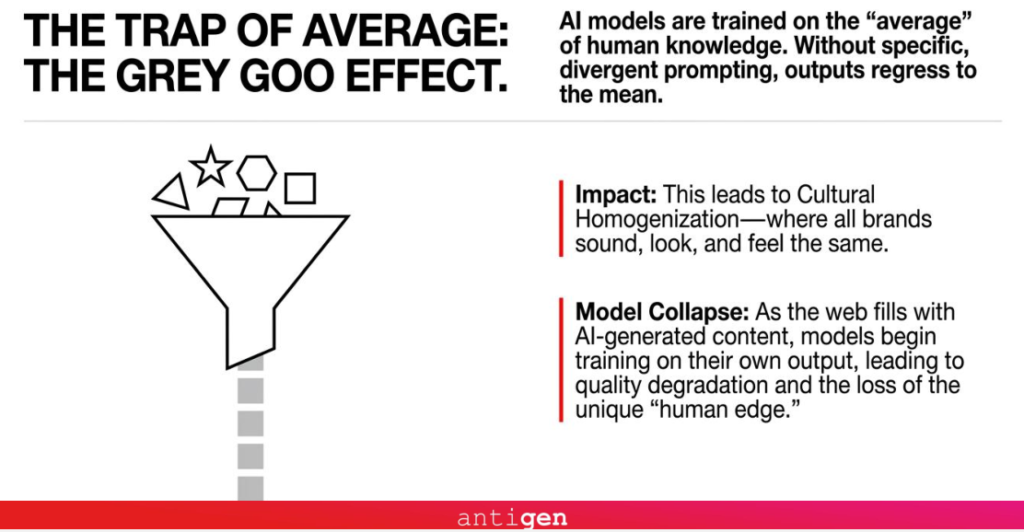
Everything else is decoration. But the way agencies use AI now is producing a strategic monoculture. The Grey Goo Effect. A slow flood of technically competent sameness. Content with no fingerprints. Brands speaking in the same sanitized accent, like they all attended the same crisis communications workshop in an airport hotel. AI models are trained on the mathematical average of human knowledge. Unless pushed by specific, divergent human prompting, they regress to the mean. That is their nature. They are average machines unless dragged, provoked, and disciplined into something sharper. When an agency uses AI as a supervisor of routine production, cultural homogenization follows. Brands begin to sound alike, look alike, feel alike. The human edge gets filed down. The weirdness disappears. The work becomes plausible and invisible, the worst possible combination. Then Model Collapse tightens the noose. AI-generated content feeds back into the system, and the models begin training on their own synthetic residue. The snake eats its tail, then writes a LinkedIn post about operational excellence. Unique perspective drains out. The creative field flattens. Everything becomes a polished room where nobody has ever had a real argument.
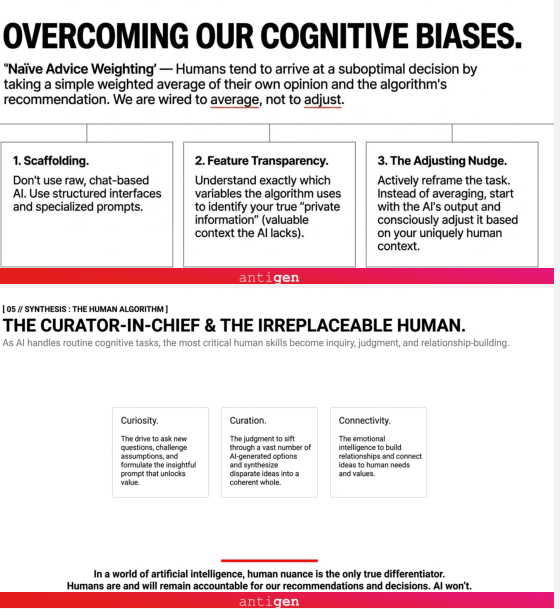
The primary psychological trap here is Naïve Advice Weighting. Behavioral research suggests humans tend to make suboptimal decisions by taking a simple weighted average between their own opinion and the algorithm’s recommendation. We are wired to average, not adjust. We compromise with the machine because it sounds confident and because confidence has always fooled busy people.
Escaping this requires The Adjusting Nudge. The human strategist starts with the AI’s output, then consciously adjusts it using private information, the context the algorithm does not have. The thing said in the client’s hallway. The cultural tension that has not reached the data yet. The ugly truth nobody put in the brief. The lived texture. The scar tissue. Without that aggressive calibration, the agency produces Grey Goo. Strategically invisible material that checks every box and leaves no mark.
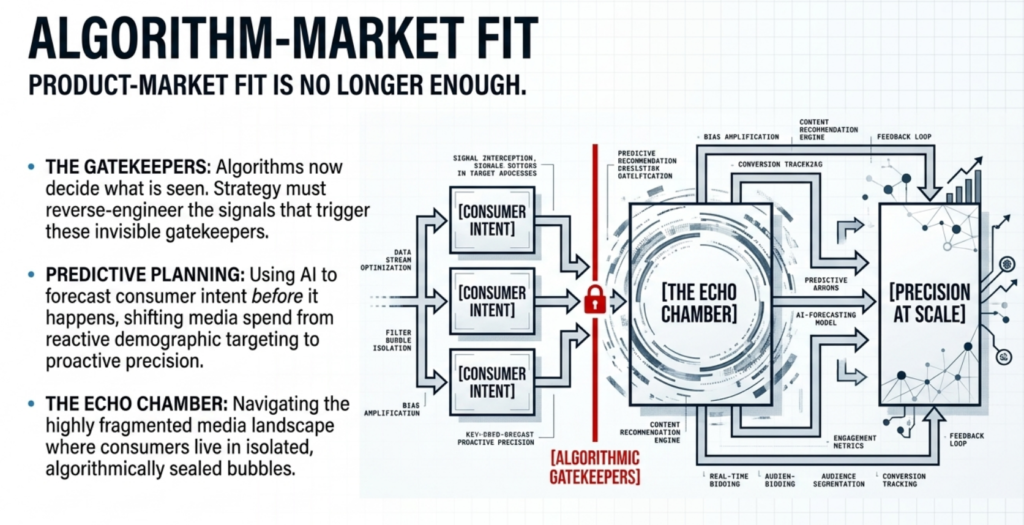
The strategist must shift from Product-Market Fit to Algorithm-Market Fit. Algorithms are now gatekeepers of visibility. They decide what surfaces, what circulates, what earns attention, what gets swallowed by the feed. Strategy has to reverse-engineer the signals that trigger these invisible curators while navigating fragmented media echo chambers.
The alternative to stagnation is the Hyper-Tail of Personalization.
The shift from One-to-Many broad segments to One-to-Moment infinite variation is where the upside lives. Mondelez used AI to create 1.6 million unique asset variations for a single campaign. That scale is mathematically impossible for the legacy agency model. No war room full of exhausted designers can manually brute-force that universe into existence.
The mistake is using AI for generic segmentation when its real power is moment-level variation. Agencies keep asking the machine to make more of the same when they should be forcing it to create infinite versions of the unique.
Escaping Grey Goo requires taste, context, and a willingness to kill sacred cows. The first cow on the floor is the billable hour. The Time and Materials model is finished. It just has not stopped twitching yet. The billable hour is no longer merely inefficient. It is structurally incompatible with an AI-accelerated market. It creates a perverse incentive system, rewarding slowness and punishing the very speed AI makes possible. That is madness dressed up as professional services tradition. When an algorithm can do in seconds what once took days, the linear relationship between time and output is permanently broken. You cannot tape it back together with a blended rate and a procurement call.
An agency still selling hours is selling a depreciating asset in a market with infinite supply. Every efficiency gain becomes a revenue threat. Every automation improvement saws at the branch the agency is sitting on. That is not a business model. That is a suicide note with line items.
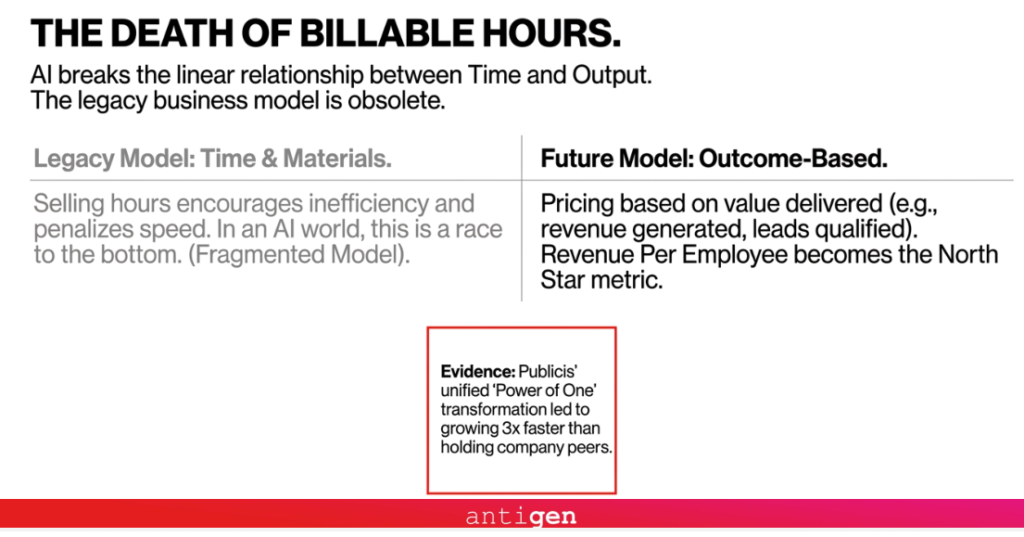
Clients are no longer willing to pay for the friction of manual process when they know the machine has removed much of that friction. They may pay for judgment. They may pay for strategic courage. They may pay for taste, risk, accountability, and the human ability to see around corners. But paying for hours because the old model said so? That spell is breaking. Revenue Per Employee must become the North Star metric for the modern firm. The agency has to shift toward value-based pricing, where it is rewarded for impact delivered, revenue generated, leads qualified, or outcomes created. The chair time matters less. The result matters more. The industry says it knows this, then continues billing like it still sells coal by the sack.
The evidence supports the pivot. Publicis’ unified Power of One transformation integrated data, creative, and tech around outcomes. The organization grew 3x faster than holding company peers and 5x faster than traditional IT consultancies. That is the Future Model in action. Recursive. Autonomous. Outcome-obsessed. The human becomes the Architect of value, not the operator of tasks. When data, creative, and technology stop living in separate little kingdoms, firms can decouple growth from headcount and begin ending the old “hire to grow” addiction that has kept agency margins thin and miserable for decades. The failure to pivot the business model is the single greatest risk to agency longevity.
The Fragmented Model of silos and manual handoffs is a liability in a world of agentic collaboration. Every unnecessary handoff is a tax. Every silo is a speed bump. Every legacy approval chain is a little shrine to dead assumptions. Agencies must stop being operators who sell labor and become orchestrators who sell intelligence. That requires a total restructuring of the labor contract. It requires abandoning Digital Taylorism and building a partnership model where human judgment is treated as the premium, not the lag in the system. The invisible handshake of the algorithm is already controlling pricing in sectors like real estate. Agencies need to define their value before the market defines it downward.
Because the market will not be gentle. The market is a butcher with clean knives.
THE HUMAN ALGORITHM: RECALIBRATING FOR THE “HUMAN PREMIUM”
The strategist’s future is not data hunter. That job is shrinking. The machine can hunt data all day without lunch, ego, or a bad back. The strategist becomes Curator-in-Chief. Taste engine. Context broker. Meaning architect. The person who decides what deserves to survive after the machine vomits out 1,000 ideas a minute. Generation has been commoditized. Ideas are cheap now. Painfully cheap. They spill everywhere, slicking the floor. The value is not in making more of them. The value is in knowing which ones have blood in them. Human value lives in curation, taste, and selection.
The workflow has to move from linear handoffs into a Co-Creative Loop. First comes Co-Inspiration, a human-led phase of divergent exploration where the human provides the initial prompts and AI expands the possibility space. Then comes Co-Generation, where the human gives strategic direction and AI rapidly generates multiple asset variations through iterative trial and error. Finally comes Co-Calibration, the human-led phase of convergent synthesis where outputs are refined, harmonized, and infused with cultural context and truth.
That word still matters. Truth. The machine can generate plausible language. It can imitate confidence. It can produce something that looks like thought from across the room. But it cannot know the private heat of a market, the shame under a consumer behaviour, the resentment inside a category, the emotional bruise a brand keeps poking without realizing it.
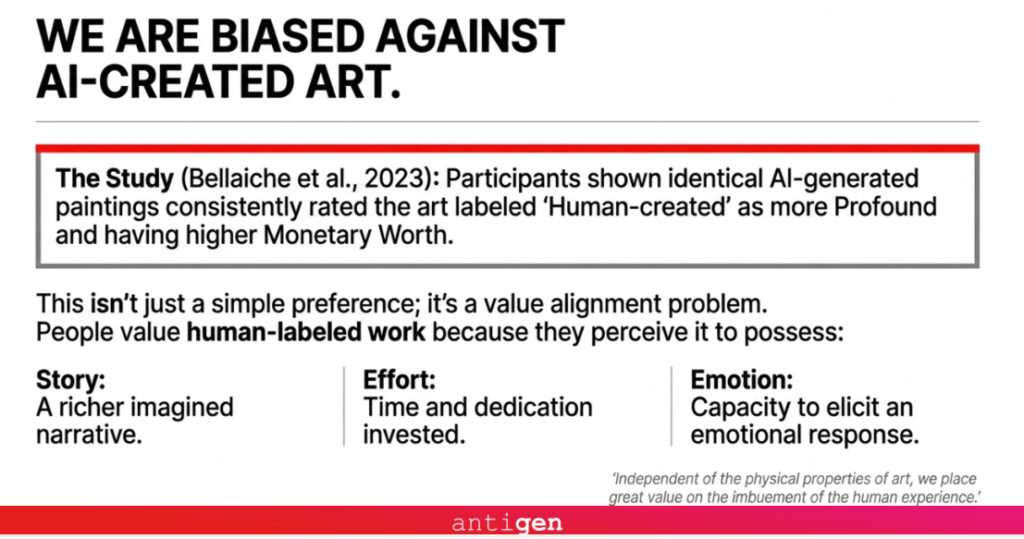
Agencies must justify and lean into the Human Premium. Research from 2023 by Bellaiche et al. indicates that people value human-created work 2-3x higher than identical work labelled as AI-generated. This is not sentimental fluff. It is a value alignment problem. Humans price Story, Effort, and Emotion into creative output. They care about the imbuement of human experience, the creation narrative, the sense that another person wrestled with the thing.
As AI handles routine cognitive tasks, agencies must shift their value proposition toward the qualities automation cannot own. Human interaction becomes a luxury service. Judgment becomes margin. Trust becomes inventory. Taste becomes leverage. We are no longer operators of tools. We are architects of meaning. High-risk strategic challenges require a Companion dynamic, open, reciprocal, demanding. Not a surveillance cage. Not a command chain. Not some anxious middle manager using AI to squeeze “lag time” out of people whose best thoughts may arrive during a walk, a shower, a cigarette, a silence. The future of the agency belongs to whoever can imbue the machine with the most meaning.
The algorithm is the utility. Humanity is the luxury. The most critical human skills in the new symbiosis are not technical in the narrow, certification-hungry sense. They are inquiry, judgment, and relationship-building. Strategists need the curiosity to ask what the machine has not been trained to ask. They need the emotional intelligence to connect machine output to genuine human needs. They need the backbone to remain accountable for recommendations AI can never truly own. Responsibility cannot be automated. Accountability does not fit inside the model.
The agency that understands this will not just survive the Great Remaking. It will lead it. But only if it keeps human intelligence at the centre of the co-creative loop and stops confusing speed with salvation. The machine can move fast. Meaning still has to bleed a little before anyone believes it.