
“The true measure of a place is whether its young must leave it to become who they dream of being.”
A manifesto for turning a place the world admires into a place its young can believe in.
Note: This essay is a manifesto and strategic hypothesis, not a representative survey of all young people in the region. Its portrait draws on public research into migration and tea-garden labour, wider Indian Gen Z research, infrastructure and tourism-carrying-capacity studies, and qualitative discussion in the Reddit community currently indexed as r/DarjeelingCity. Online community discussion is useful for language and nuance, but it overrepresents English-speaking, digitally confident, urban, student, professional, diaspora and tourism-adjacent voices.
Darjeeling has a peculiar problem.
Everyone knows it. Almost nobody sees it. The world knows the tea. The Toy Train. Kanchenjunga on a clear morning. Colonial roofs disappearing into mist. School stories. Mall Road. A certain idea of mountain charm polished by a century and a half of other people looking at it.
What the world does not know nearly as well is contemporary Darjeeling: the people who live behind the view, the young people building taste, language, music, fashion and ambition inside it, and the quiet contradiction shaping their lives.
They are intensely proud of where they come from. They are increasingly unsure whether they can build the life they want there.
This is not simply an unemployment problem. It is not simply a tourism problem. It is not simply a cultural-recognition problem. It is what happens when a place is globally visible but locally unable to convert that visibility into possibility.
Darjeeling’s young do not necessarily want to stay home forever. They want to leave without being exiled by economics. They want to study, travel, work, earn, experiment, become culturally and professionally modern, and still retain the option of returning to a home capable of meeting the person they have become.
That option is currently fragile. The question behind this essay is therefore not how to persuade young people to stay. Sentiment is a poor substitute for opportunity. The more interesting question is whether Darjeeling can create something powerful enough to change the direction of aspiration itself.
Can it become a place young people move towards, not merely a place they move away from?
And could culture, specifically a world-class, place-anchored music and ideas festival, provide the catalytic moment?
Not solve everything. Not manufacture pride that does not exist. But make the country look up in awe and allow Darjeeling’s young to say, with complete conviction: we made this.
1. THE NORMALISATION OF DEPARTURE
The most important fact about young Darjeeling is not simply that many leave. It is that leaving has become normal enough to feel like the natural order of things.
Grow up in the hills. Leave for college or training. Find work in a larger city. Build a life there. Maintain family, language and identity across distance. Return for holidays, family obligations and the occasional fantasy of a different life.
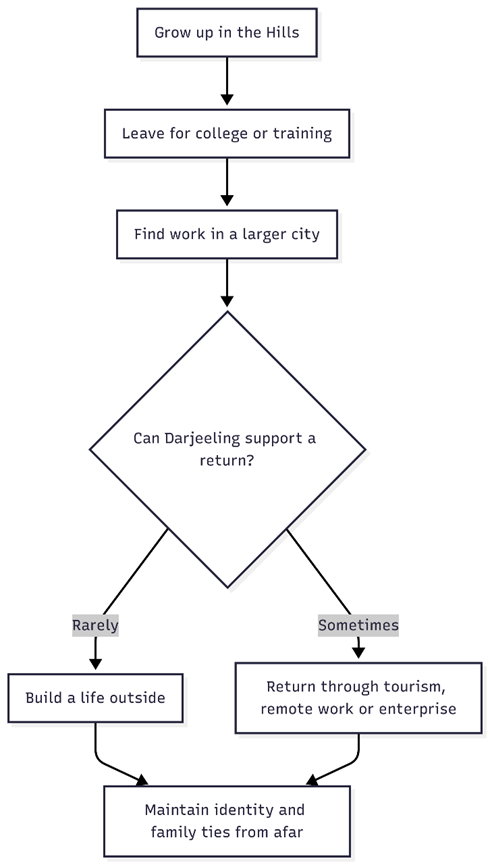
Delhi, Bengaluru, Kolkata, Pune, Hyderabad, Mumbai and the Gulf are not merely symbols of excitement. They are practical employment markets. Nursing, hospitality, aviation, education, the armed forces, customer service, retail, technology and corporate support functions offer recognisable ladders. Darjeeling offers fewer.
This does not make migration a tragedy by definition. Many young people want exposure, independence and the liberating anonymity of a larger place. They want to discover who they are beyond the neighbourhood, family and school that have always known them. They should.
The wound lies elsewhere. Leaving often feels compulsory rather than chosen.
That distinction matters. Voluntary mobility expands a life. Forced mobility reorganises it around absence.
“People leave Darjeeling to find jobs. You’re doing it in reverse.”
— Reddit user responding to someone planning to move to Darjeeling for work. Source: r/DarjeelingCity
Darjeeling produces educated, culturally fluent and highly adaptable young people, then exports them into economies that can use them more effectively than their home can. Families invest in education; other cities capture the productive return. The hills retain pride, remittances, photographs and the promise that one day, perhaps, a return will become practical.
I think of this as aspirational homesickness: loving a place fiercely while preparing for a future that probably excludes it.
The homesickness begins before departure. It begins when a student understands that the most sensible version of ambition requires distance.
2. THEY DO NOT WANT TO STAY. THEY WANT THE RIGHT TO RETURN.
The usual conversation about regional youth is badly framed. It asks how to create enough jobs to stop migration, as if movement itself were failure.
Darjeeling Gen Z is not anti-migration. It is anti-no-choice migration. The ideal is not: never leave.
The ideal is: leave to learn, earn and grow; return because there is something worth returning to.
That requires more than a cluster of vacancies. It requires a return economy: professional roles, creative networks, remote-work infrastructure, capital, cultural life, liveable public systems and a sense that the most interesting years of one’s life need not happen somewhere else.
Like Gen Z across India, Darjeeling’s young want financial independence, purpose and some control over the shape of work. Here, however, financial independence carries a particular charge. It can mean escaping dependence on an unstable tourist season, an underpaid tea economy, informal work or a family already stretched to finance education outside the hills.
They are not necessarily asking for a job for life. They are asking for a credible path:
- education that leads somewhere;
- training connected to real employers;
- internet and infrastructure good enough for remote work;
- capital and permissions for small enterprise;
- tourism work that produces careers rather than only seasonal gigs;
- and a way home after experience has been acquired elsewhere.
Entrepreneurship will be part of this, but it cannot become an alibi for the absence of a proper economy. Darjeeling’s natural entrepreneurial imagination is shaped by what it already possesses: homestays, cafés, food, tea, trekking, cycling, music, photography, filmmaking, fashion, organic produce, language media and sustainable tourism.
These are real opportunities. They are also finite. “Start a homestay” cannot become the Himalayan equivalent of telling every unemployed graduate to launch a startup.
A healthy future requires both independent enterprise and serious salaried work. It requires routes into the national economy and reasons for parts of that economy to locate themselves in the hills.
3. THE PLACE THEY LOVE IS NOT THE TOURIST BROCHURE
Darjeeling’s young love Darjeeling more critically than the visitor does.
Their emotional map is not only Tiger Hill, tea gardens and the Toy Train. It is Chowrasta after the crowds have thinned. School routes. Football grounds. Shared taxis. Shortcuts between neighbourhoods. Familiar shopkeepers. Bakeries. Local cafés. Music venues. Roadside food. The particular relief of seeing Kanchenjunga when the clouds finally move.
The strongest affection is often accompanied by complaint. That is not ingratitude. It is ownership. Young residents can love the town and resent the tourist gaze at the same time. Tourism supports households and businesses; it also produces a version of Darjeeling in which the visitor’s experience is more visible than the resident’s life.
The irritation is not with visitors as a category. It is with a pattern of consumption: littering, traffic, bargaining that undervalues local labour, photographing private life as exotic texture, romanticising simplicity while residents buy water, and imagining relocation without understanding land, infrastructure or carrying capacity.
“Water shortages to traffic jams, which lead to kids missing exams. The garbage pile hidden from tourists but always visible to locals makes me wonder: when did we stop being not okay with all this?”
— Lightly punctuated for readability; wording retained. Source: r/DarjeelingCity
Darjeeling is marketed more effectively than it is lived. Water shortages, tanker dependence, traffic jams, waste, unstable roads and construction pressure are not side notes to the experience of place. They are the experience of place. Ecology here is not a fashionable global issue. It is immediate infrastructure: the slope, the spring, the road, the monsoon, the landslide and the limits of what a mountain town can absorb.
This is why the young person’s relationship with tourism is split. They want Darjeeling to prosper from being seen. They do not want it reduced to scenery.
4. IDENTITY IS NOT A COSTUME
Nepali is not simply a language used to communicate. It carries humour, intimacy, music, memory and belonging. Darjeeling’s young can move naturally between Nepali, English and Hindi, with Bengali and other regional languages entering according to place and circumstance. Their culture is not sealed. It is promiscuously contemporary.
They can consume Nepali hip-hop, Korean pop, Hindi cinema, English-language streaming and a local reel in the same afternoon. They can inherit the guitar culture of Darjeeling and push it through electronic music, rap, fashion, comedy, design and short-form video.
What they do not necessarily want is to have culture preserved on their behalf as folklore.
Living culture does not sit behind a rope waiting to be photographed. It mutates. It borrows. It argues. It dresses differently. It finds a beat. It turns memory into something that can travel.
This comes from a politically charged discussion, but the emotional observation can stand independently:
“We’re a community with no home, backed into a corner for identity.”
And later:
“There is no perfect solution, only band-aids for a wound that always grows wider.”
The same is true of food. Momos, thukpa, wai-wai preparations, sel roti, aloo dum, churpee, sekuwa, tea and bakery culture are comfort, identity, content and enterprise at once. They allow Darjeeling to explain itself without surrendering ownership of the explanation.
Young Gorkhas also carry a form of identity that is not always elective. Outside the hills, appearance, accent and other people’s assumptions can impose it before they have spoken. Being treated as culturally external, or having one’s nationality casually misread, gives recognition an everyday importance that outsiders often underestimate.
The point is not to retreat into identity. It is to make identity spacious enough to contain modernity. Darjeeling’s young are not rejecting their inheritance. They are trying to renegotiate it. They want the right to become modern without being required to stop belonging here.
5. ONE GENERATION, SEVERAL DARJEELINGS
“Darjeeling youth” is a useful phrase and a dangerous simplification. A student in an English-medium school considering a master’s degree in Bengaluru inhabits a different opportunity structure from the child of a tea-garden worker trying to avoid reproducing a low-wage life. A rural hill student concerned with transport and connectivity does not experience the region in the same way as a creator in town or a young hospitality worker navigating seasonality.
The common identity is real. The material circumstances are not uniform.
| Youth environment | What becoming looks like | What threatens it |
| Town youth across Darjeeling, Kurseong and Kalimpong | Professional careers, mobility, creative enterprise and remote work | Having to leave permanently |
| Tea-garden youth | Education, secure employment, land and housing dignity, freedom from inherited precarity | Reproducing the low-wage life of the previous generation |
| Rural hill youth | Connectivity, transport, public services, education and local livelihoods | Geographic isolation and weak access |
| Tourism and hospitality youth | Better earnings, professionalisation and enterprise | Seasonality, saturation and low-value work |
| Siliguri-facing and peri-urban youth | Commerce, technology, logistics and professional education | Congestion, competition and fragmentation |
| Students and outward migrants | Qualifications, exposure and national mobility | Racism, disconnection and an impractical return |
| Young creators and entrepreneurs | Visibility, cultural production and independent income | Lack of capital, venues, networks and institutional support |
Tea-garden youth require particular attention. Education, low-wage structures and out-migration make plantation work feel less like an inheritance worth entering than a life to escape. A cultural renaissance that celebrates Darjeeling tea while keeping tea-garden youth invisible would repeat the very extraction it claims to challenge.
Any serious idea of collective pride must therefore be materially plural. The café-owning creator, the nursing student, the tea-garden graduate, the rural musician and the migrant returning from Bengaluru must be able to see a place for themselves inside it.
6. THE ARRIVAL GAP
Across India, Gen Z shares a common operating system: financial anxiety, scepticism that a degree guarantees a job, reliance on Instagram and YouTube, creator culture, impatience with ceremonial authority, growing mental-health awareness, frustration with inflation and recruitment failure, and simultaneous attraction to global culture and local tradition.
Darjeeling adds a sharper regional contradiction. It is already famous, but not for its future. Many towns are trying to become visible. Darjeeling has visibility but lacks sufficient control over what that visibility means. Its brand is enormous; the number of contemporary professional and creative ladders built on that brand is remarkably small.
This is the arrival gap.
Young people know they come from somewhere exceptional. They do not consistently experience the external validation, institutions or opportunity that exceptional places are supposed to produce.
The six tensions are clear:
| They want | They experience |
| Pride in Gorkha identity | The flattening of a living identity into shorthand and stereotype |
| Modern careers | An economy concentrated in tourism, tea and a narrow service base |
| Freedom to leave | Anxiety that leaving will become permanent exile |
| More visitor income | Congestion, waste, water pressure and cultural disrespect |
| National inclusion | Racial stereotyping and questioned belonging |
| Global cultural participation | A place still represented primarily through nostalgia |
Jobs, recognition, culture, mobility and self-worth are not separate boxes. They meet inside one underlying demand:
Give us the right to become modern without requiring us to stop belonging here.
7. FROM YOUTH ANXIETY TO A PLACE THE WORLD DESIRES
If the underlying issue is partly one of identity, self-worth and pride, the answer cannot be another communication campaign telling Darjeeling’s young people to feel proud of where they come from. Pride cannot be manufactured through slogans when the visible structure of opportunity continues to tell them that consequential careers, contemporary culture and national recognition happen somewhere else.
What Darjeeling may need is not simply a youth programme, but a place-defining cultural property: an institution, experience or annual moment so distinctive that it changes both how the rest of India sees Darjeeling and how young people in Darjeeling see themselves.
The psychological objective is a reversal of direction.
For generations, ambitious young people have left the hills to find education, employment, audiences, collaborators and cultural energy elsewhere. A place-defining property would make talent, attention, capital and curiosity travel in the opposite direction. Instead of asking, “How do I get out of Darjeeling to be part of something important?”, young people elsewhere would begin asking, “How do I get to Darjeeling to experience what is happening there?”
That is the real meaning of “having arrived.” It is not simply tourism, celebrity attendance or a large crowd. Darjeeling already attracts visitors and already possesses national recognition. The problem is that much of this recognition belongs to its scenery, tea, colonial history and weather, rather than to its living contemporary culture or its young people.
Darjeeling is admired as a destination, but not yet sufficiently recognised as a producer of what comes next.
A successful cultural property would shift the story:
| From | To |
| Darjeeling as a beautiful inheritance | Darjeeling as a contemporary cultural force |
| A place young people leave to find opportunity | A place talent travels to find inspiration |
| Local culture presented as tradition | Local culture experienced as invention |
| Young residents as workers in a tourism economy | Young residents as creators, curators and owners |
| Pride based primarily on the past | Pride proven by present-day capability |
| National attention directed at the landscape | National attention directed at the people |
This kind of transformation has precedents. Kochi did not become globally relevant to contemporary art by pretending to be London or Venice. The Kochi-Muziris Biennale created a cosmopolitan cultural language rooted in the city’s own history, spaces and multiple identities. Its founding ambition was explicitly to construct a form of modernity emerging from Kochi’s lived experience rather than subsuming local difference into an imported idea of the contemporary. Kochi-Muziris Biennale overview
Dharamshala’s international film festival began with the relatively modest objective of giving its local community access to alternative cinema. It has since become one of India’s leading independent film festivals, drawing filmmakers and audiences into the mountains while continuing to run fellowships, travelling screenings and film-appreciation programmes for local students. Dharamshala International Film Festival and DIFF community initiatives
Jaipur’s literature festival turned a city associated primarily with palaces, tourism and heritage into one of the world’s major annual meeting places for writers and ideas. Its organisers report that it has hosted more than 8,000 writers, speakers and artists and welcomed over five million visitors since its inception. Jaipur Literature Festival
The point is not that Darjeeling should copy any of them. It is that a cultural property can become a form of public infrastructure. At its best, it produces reputation, networks, skills, employment and confidence at the same time. It gives a place an annual appointment with the world.
WHAT COULD DARJEELING CREDIBLY OWN?
Several ideas could perform this function. Each would express a different version of what Darjeeling wants to become.
EVALUATING THE OPTIONS
| Cultural property | Youth ownership | National visibility | Global potential | Economic pathways | Ability to change Darjeeling’s image |
| Contemporary Himalayan Biennale | Medium | Medium | High | Medium | High |
| Film and Storytelling Festival | Medium | High | High | Medium | High |
| Himalayan Futures Forum | Low–Medium | Medium | High | High | High |
| Tea, Food and Design Movement | Medium–High | Medium | Medium–High | High | Medium |
| Mountain Games and Adventure Property | High | Medium–High | Medium | High | Medium–High |
| Music and Contemporary Culture Festival | Very high | Very high | High | High | Very high |
The conclusion is not that the other ideas should be discarded. In fact, the strongest long-term property may eventually contain elements of all of them. The deeper opportunity is a contemporary Himalayan cultural institution, with music as its gravitational centre and film, art, fashion, food, ecology, ideas and adventure as connected worlds.
Music is therefore not simply one event option among many. It is the most powerful entry point into a larger place-making strategy.
It offers the best combination of emotional intensity, mass participation, visual spectacle, cultural authenticity and national desirability. A film festival may make Darjeeling respected. A futures forum may make it important. A design biennale may make it sophisticated. A global music and culture festival has the potential to make Darjeeling wanted.
THE TEST IS NOT FAME, BUT AUTHORSHIP
Whatever form is chosen, the essential question is not whether the property attracts famous people or outside attention. It is whether Darjeeling owns what that attention produces.
A cultural property will strengthen self-worth only when local young people are visible as musicians, filmmakers, designers, technicians, curators, entrepreneurs, producers and decision-makers. If outsiders own the brand, programme, audience data, content rights and commercial upside while Darjeeling provides scenery and temporary labour, the project will repeat the very hierarchy it was intended to reverse.
The property must therefore satisfy five tests:
- It must be inseparable from Darjeeling’s living identity, not merely located in its landscape.
- It must allow local youth to create and govern, not only attend or volunteer.
- It must produce year-round skills, networks and economic opportunities.
- It must be accessible enough for residents to experience it as theirs.
- It must possess a level of originality and execution that makes the rest of the country feel it is missing something.
The desired reaction is not simply, “Darjeeling looks beautiful.”
It is: “How did Darjeeling create this before the rest of us did?”
That is the point at which cultural recognition begins to affect collective self-worth. Darjeeling stops appearing as a place waiting for development, rescue or discovery. It becomes a place capable of producing a future that others want to enter.
The music festival should be evaluated within that larger ambition. Not as three days of entertainment, and not as an extravagant tourism event, but as the possible flagship of a ten-year project to turn Darjeeling from a celebrated landscape into one of South Asia’s most compelling centres of contemporary Himalayan culture.
NOTES AND SOURCES
This essay is a manifesto and strategic hypothesis, not a representative survey of all young people in the region. Its portrait draws on public research into migration and tea-garden labour, wider Indian Gen Z research, infrastructure and tourism-carrying-capacity studies, and qualitative discussion in the Reddit community currently indexed as r/DarjeelingCity. Online community discussion is useful for language and nuance, but it overrepresents English-speaking, digitally confident, urban, student, professional, diaspora and tourism-adjacent voices.
Key sources include research on international migration of women from Darjeeling, labour out-migration from Darjeeling tea gardens, the Deloitte India Gen Z and Millennial Survey, the Ministry of Environment report on Himalayan tourism submitted to the National Green Tribunal, and a study of sustainable transport in Darjeeling.
Festival precedents were read through the Ziro Festival, the Government of India’s Ziro festival listing, the Wonderfruit manifesto, Glastonbury Festival and reporting on the environmental tensions surrounding destination music festivals.