
The anatomy of India’s urban loneliness: a year of Reddit confessions from nine cities, and the missing machinery that turns strangers into friends.
A 29-year-old in Mumbai, stable job, decent health, the full middle-class checklist ticked, went on Reddit this year to describe his life as quietly lonely. He wasn’t asking for a date, and he was very clear he wasn’t networking either. He wanted something the city seemed to have no word for. That post sits somewhere in a year of Indian Reddit, September 2025 to September 2026, trawled across nine city communities: Ahmedabad, Bangalore, Chennai, Coimbatore, Delhi, Hyderabad, Kolkata, Mumbai and Pune. Friend-seeking posts, WFH laments, weekend-boredom threads and the comment sections underneath, where the real anthropology happens. Forty-four first-person narratives were coded line by line, and the whole heap was laid against the Meta-Gallup Global State of Social Connections survey and the WHO’s 2025 Commission on Social Connection so the anecdotes would have a spine.
The caveat first, because the loneliness discourse is choked with people who skip it. Reddit is a lousy census. Its Indian users skew young, urban, English-speaking, digitally fluent and male. Some city subreddits herd friendship posts into megathreads, and Coimbatore’s restricts companionship solicitation outright, so a city that looks lonelier may simply have chattier users or sleepier moderators. What Reddit gives you is something a survey can’t. It shows you the wiring, in people’s own clumsy lowercase words.
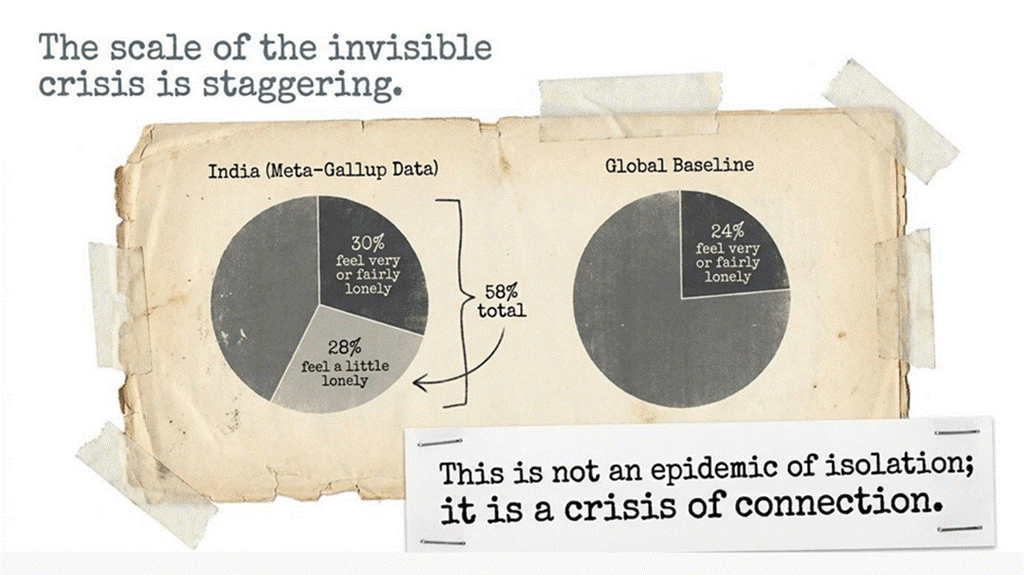
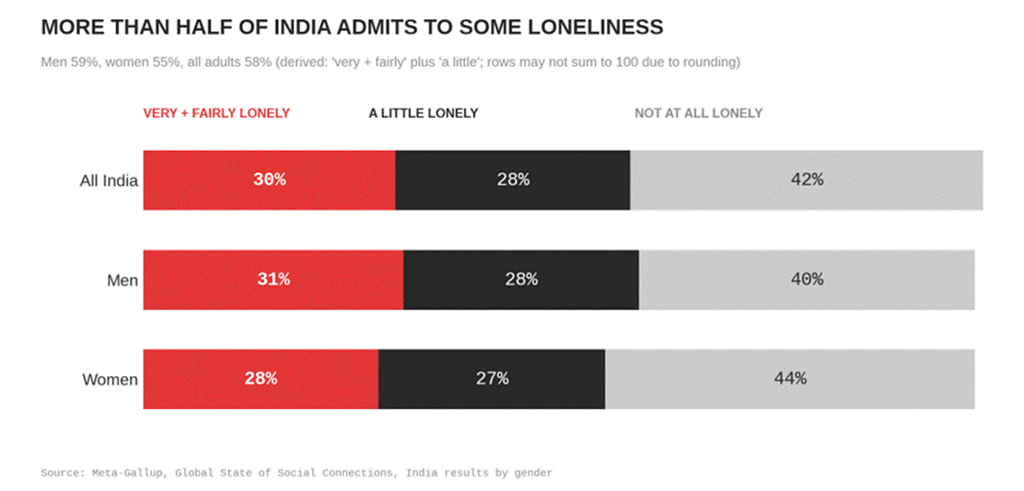
The survey supplies the scale. Meta-Gallup asked people in 142 countries, between June 2022 and February 2023, roughly a thousand respondents a country, how lonely they felt. In India, 30% said very or fairly lonely.
The global figure was 24%. Another 28% of Indians said a little lonely, and only 42% said not at all. Add the first two buckets and you get 58% of the country owning up to at least some loneliness.
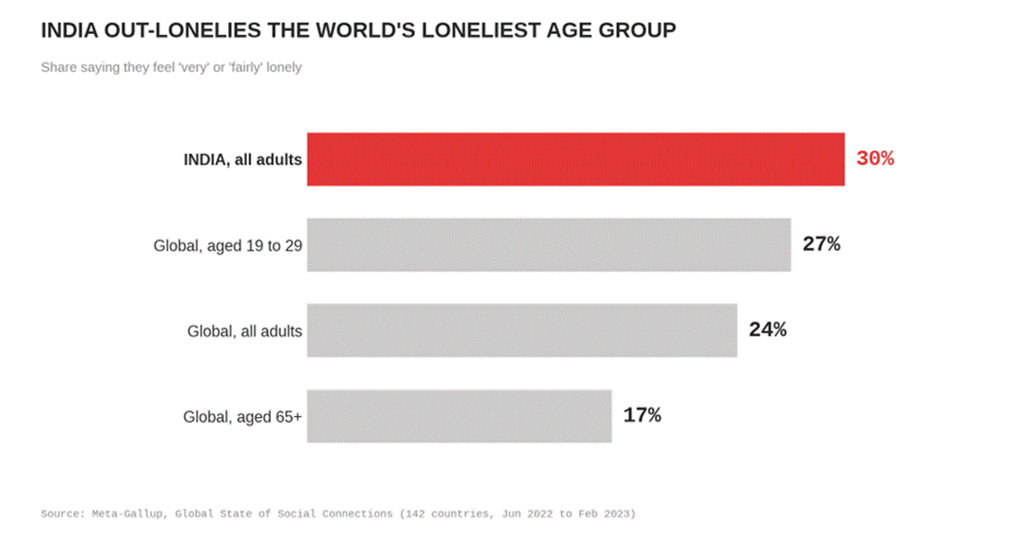
India’s 30% sits three points above even the global figure for young adults aged 19 to 29, the loneliest age band on the planet, at 27%. Hold that up against the national self-image of joint families and a WhatsApp group of 247 cousins forwarding sunrise GIFs, and the arithmetic refuses to reconcile.
India’s share of adults reporting they feel very or fairly lonely, against global Meta-Gallup benchmarks. Source: Meta-Gallup, Global State of Social Connections.
The WHO counts differently and lands lower: about 15.8% of people globally experience loneliness, climbing to 20.9% among adolescents and 17.4% among 18 to 29 year olds. Different question, different threshold, so you can’t staple the numbers together. The shape agrees, though. Loneliness is substantial, and the young carry more of it.
The WHO also warns, sensibly, against the lazy “epidemic” headline, since the evidence doesn’t show loneliness climbing everywhere in a neat straight line. What the data holds up is this: urban India has a large, structural social-connection problem, and strangers on Reddit have been documenting its mechanics from the inside, for free.
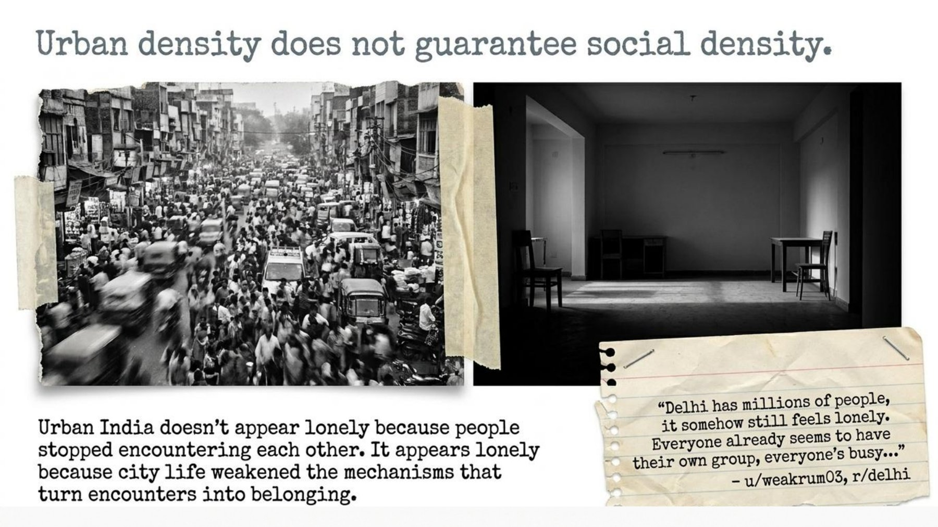
Start with density, because density is the great con of the Indian metro. We sell our cities as crowded, chaotic, alive. A Delhi user put the paradox better than a shelf of sociology: “Delhi has millions of people, it somehow still feels lonely.
Everyone already seems to have their own group, everyone’s busy…” A Mumbai poster reports from inside the office: “So, while I have colleagues, I don’t really have anyone at work whom I can call a friend.”
Look closely at who’s talking. These are rarely hermits. They have roommates, spouses, family groups pinging good-morning roses at 6 a.m., college friends in Gurgaon.
What’s missing is a person who is nearby, compatible and easy to activate. Someone you can message at seven in the evening with a single word, chai?, and get a yes without either of you opening a calendar. Ordinary companionship is sought in 26 of the 44 coded narratives, 59%. A walk, a film, street food, a plan that forms and happens on the same evening. “I really miss having people where you can randomly make plans,” one poster writes. Nobody in that sample was asking for a party. The deficit is usability. The network exists on paper and fails in practice.
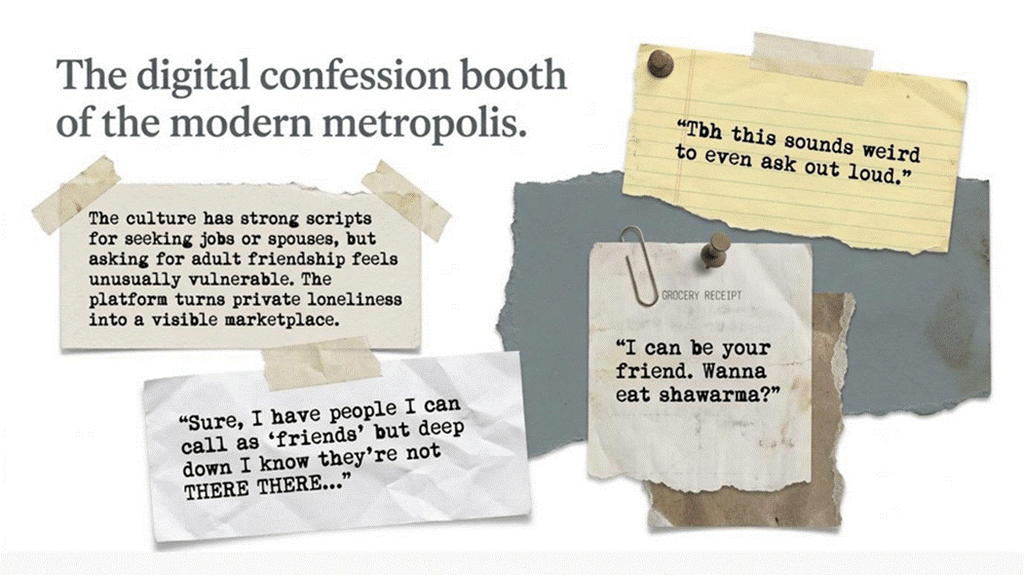
A need with no socially respectable name ends up on a semi-anonymous forum, typed with one thumb and wrapped in apology. “Tbh this sounds weird to even ask out loud,” confesses a Bangalore newcomer. Adult Indian life is thick with institutions and scripts. We have elaborate machinery for finding a spouse (ask any aunty with a biodata folder), a job, a flatmate, a tuition teacher, a date. We have almost nothing whose stated purpose is to help a grown adult find a friend and keep seeing them. We’ve built a culture where asking for a wife is routine and asking for a mate is embarrassing.
Reddit lets you confess the need without first confessing it to anyone you know. Then the comments do something lovely and slightly absurd. “Same.” “DM.” “Where do you stay?” One Delhi reply cuts straight through the awkwardness: “I can be your friend. Wanna eat shawarma?” Loneliness briefly becomes collective, and you get a near-perfect paradox, a community of people who each believe they have no community. What they’re describing, when you read closely, is rarely a shortage of bodies. Seventeen of the 44 narratives, 39%, describe a quality mismatch. “I do have a few office friends… but I just don’t feel that click, you know?” writes a Pune woman. Another goes further: “Sure, I have people I can call as ‘friends’ but deep down I know they’re not THERE THERE…” That capitalised THERE THERE carries more analytical weight than most research abstracts.
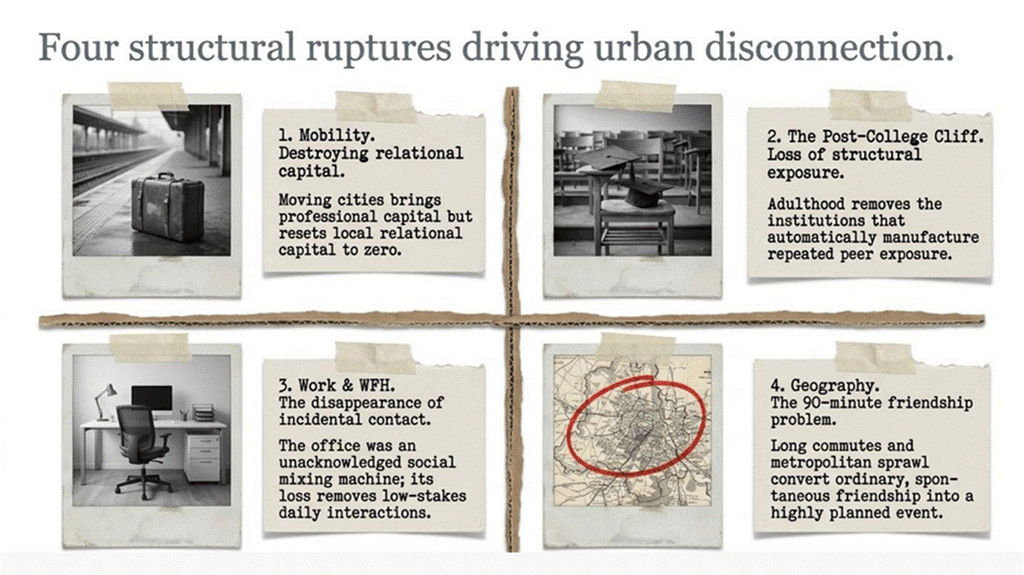
The machinery breaks at four points, and they recur so consistently they read like an assembly line running in reverse. The first is the move. Mobility shows up in 26 of 44 coded narratives, 59%. A 22-year-old writes that he “recently moved to Hyderabad and honestly finding it a bit difficult to meet people outside of work.” A Bangalore newcomer: “I’m new to the city and have no friends here … was wondering if anyone can give tips on how to meet ppl ig?” That trailing ig is heartbreaking in its shrug. Land the job, find the flat, argue with the broker, collect some colleagues, then hit the first free Saturday and discover the city’s social layer didn’t ship with the offer letter. You arrive carrying professional capital and your local relational capital resets to zero.
The second is the post-college cliff. School and university are friendship factories disguised as educational institutions. Same-age cohort, synchronised timetables, shared canteen, oceans of unstructured time. Friendship falls out of that like sawdust off a lathe. “In college finding friends was easy but now it has become very difficult,” writes a Pune poster. The median stated age in the coded corpus is 24, roughly the week the factory shuts its gates.
The third is the office evaporating. A Hyderabad man wrote in February, “I really miss the casual human connection you get in an office,” and he’s grieving something nobody ever budgeted for: the lift ride, the four o’clock cutting chai, the guy from accounts who on some random Tuesday announced he was going down for momos. Work appears in 23 of the 44 narratives, 52%, and nine of them, 20%, explicitly involve working from home. Among the WFH narratives, 78% name loneliness or isolation outright, against 43% of the rest. Self-selected sample, not causal, but as a hypothesis for anyone with a survey budget it’s screaming. One person tried co-working and found it “sitting in a crowd with zero actual interaction,” which kills the easy fix. Physical proximity was never the magic. The office gave people permission to talk without having to admit they needed to. Take away the tea break and you remove the alibi.
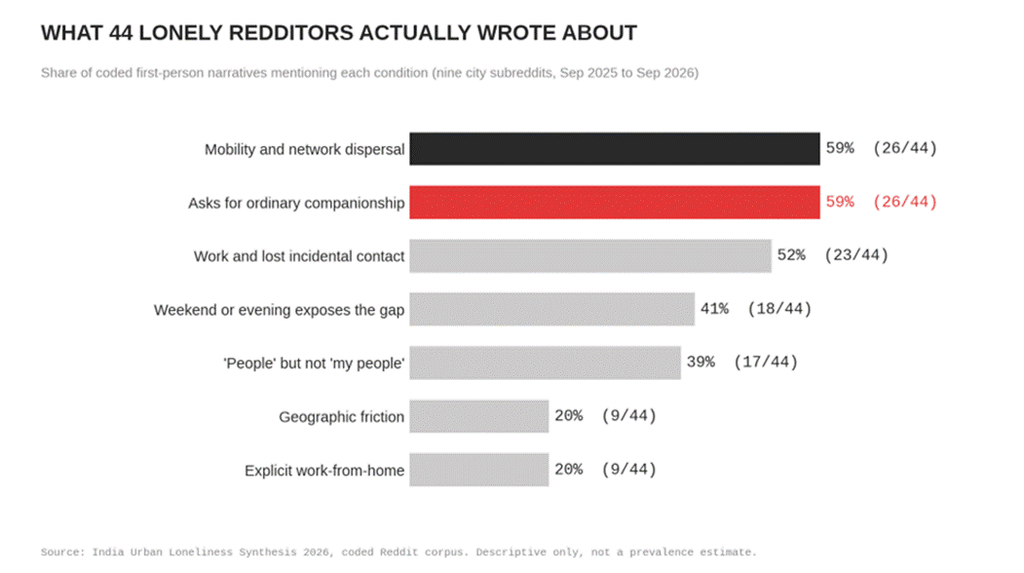
Conditions mentioned across the 44 coded first-person Reddit narratives. Descriptive of the corpus only; not a prevalence estimate. Source: India Urban Loneliness Synthesis 2026.
The fourth is geography. The Indian metro is a federation of islands connected by traffic. “I also have a few college friends who work in Pune, but they live quite far away.” In Hyderabad, a hangout suggestion gets the reply, “It’s too far for me though. Anything in Secunderabad?” The reports call it the 90-minute friendship problem, and anyone who has tried meeting a friend in Noida from Dwarka on a weekday knows the arithmetic. Two commutes, a calendar negotiation and an Uber surge turn a casual hangout into an Event, and events happen far less often than life does.
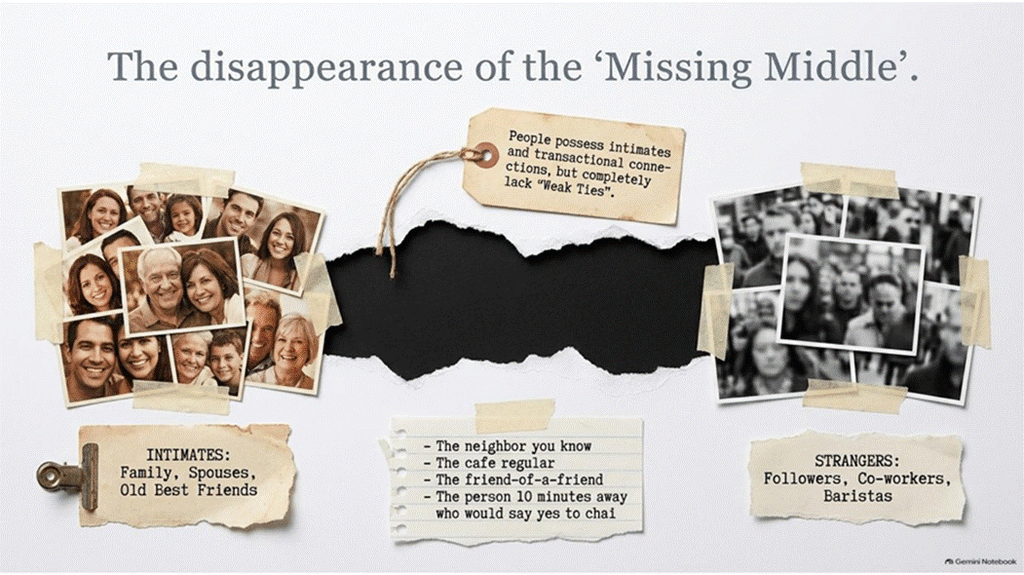
Put those ruptures together and you get the single most useful idea in the whole stack: India’s missing middle. At one end of your social world sit the intimates. Parents, partner, the best friend from school you speak to twice a year for three hours straight. At the other end sit strangers and transactions: the Zomato rider, the dhobi, 1,200 LinkedIn connections, a Hinge match gone quiet. What’s thinning out is the layer between. The neighbour whose name you actually know. The regulars at the café. The friend of a friend. The person ten minutes away who might say yes to chai.
That middle layer looks trivial and is anything but. It’s the nursery for every strong friendship you’ll ever have. Hardly anyone meets their closest friend in one thunderclap of compatibility. They meet someone vaguely compatible over and over, at low stakes, until one day it’s a friendship and neither can say when it happened. A Mumbai commenter describes going to the same café until “you develop a bond with the staff and the other regulars there and it just becomes a place of comfort.” The entire engine of adult friendship, in one comment by someone who probably just wanted to recommend a café.
■ ■ ■
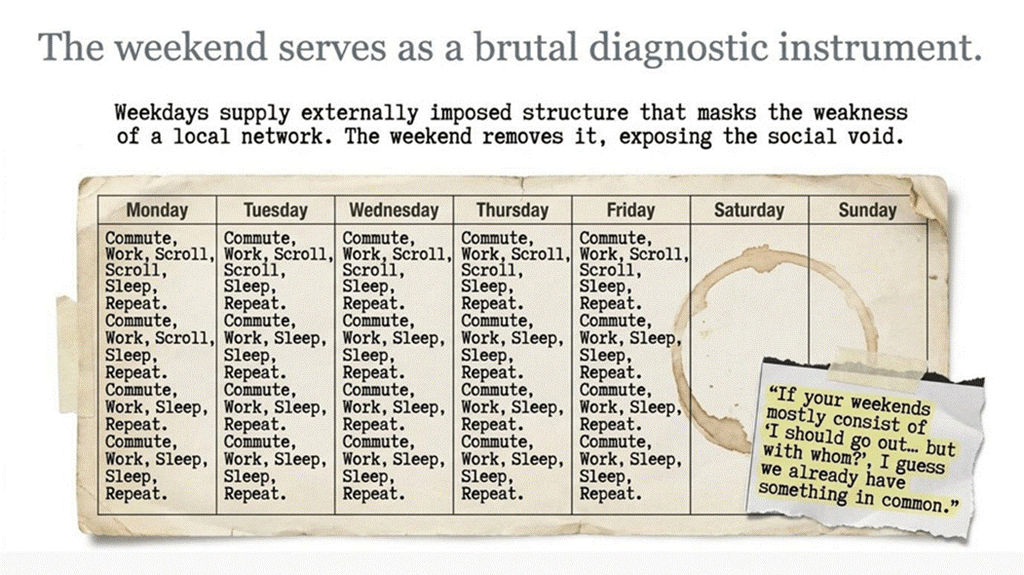
Then comes my favourite finding, because it’s so exact: the weekend. Monday to Friday, the calendar is scaffolded by someone else. You can function beautifully for years without noticing that your social network has flatlined. Saturday pulls the scaffolding away and the building sags. “If your weekends mostly consist of ‘I should go out… but with whom?’, I guess we already have something in common,” writes someone in Delhi. In 41% of the coded narratives, weekends, evenings or holidays are when the gap turns visible. Urban loneliness in India keeps office hours of its own, and it clocks in on Saturday morning.
This explains the peculiar grammar of these threads. They’re mostly logistics. Anyone for badminton? Coffee in Indiranagar? Running at Cubbon? The activity barely matters. “Anyone for badminton” is a sentence a grown man can type in public. “I’m lonely, would somebody please spend time with me” is a sentence almost nobody can. The shuttlecock is a permission slip.
Now gender, where the data gets properly interesting and the popular story about a “male loneliness epidemic” turns out to be half a story. Meta-Gallup’s India numbers do lean male.
Thirty-one per cent of Indian men say they’re very or fairly lonely, against 28% of women, and 40% of men say not at all lonely, against 44% of women. Fold in the a-little-lonely bucket and it’s 59% of men and 55% of women carrying at least some of it.
Globally the headline gap is zero, 24% for both. India tilts slightly male.
India loneliness distribution for all adults, men and women. Derived “at least a little lonely” totals are the sum of the first two categories. Source: Meta-Gallup, Global State of Social Connections.
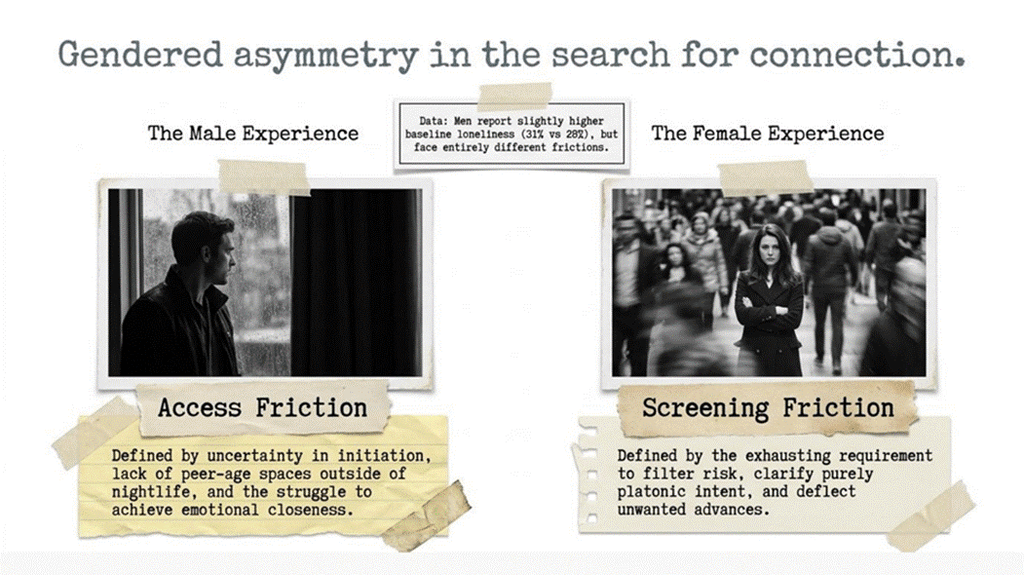
Men and women are fighting different wars on the same terrain, though. For many men the war is access.
How to begin, whom to approach, where to find peer-age spaces that aren’t a nightclub, how to get past banter into anything resembling closeness, how not to look like a weirdo at the Sunday run club.
For many women every bit of that applies, and then a second war opens on top of the first.
■ ■ ■
Call it the screening tax. Among narratives where gender was stated, safety or boundary friction shows up in 8 of 12 women’s posts, 67%, and in zero of 12 men’s. Tiny numbers, self-selected, but you don’t need a p-value for this one. A 26-year-old Ahmedabad woman asks how to build a social life, then adds an edit: “Please don’t slide in with creepy DMs!!!” Three exclamation marks.
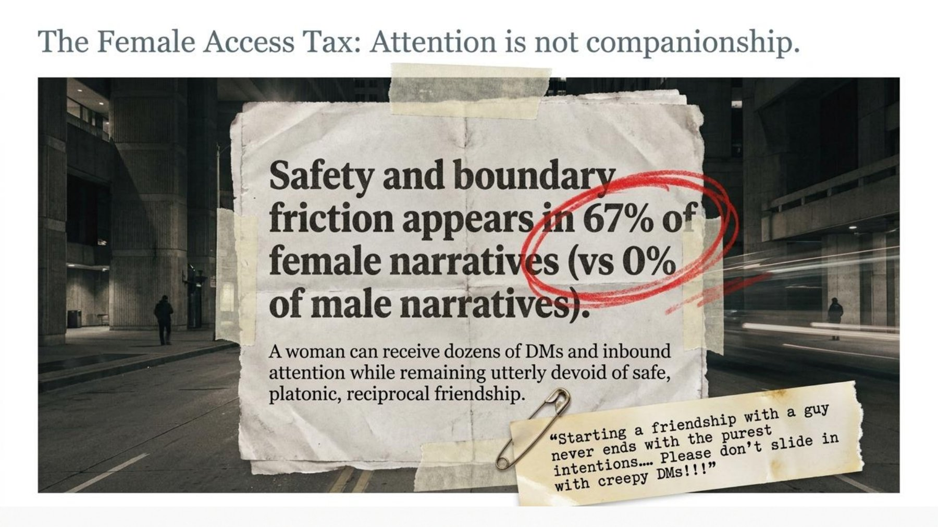
You know exactly what her inbox looked like before she added them. A Pune user asks how people socialise “without risking their safety.” A Delhi commenter says starting a friendship with a guy “never ends with the purest intentions.” A married woman in Mumbai reports that even an explicitly women-only friendship post got swarmed by men.
A woman can be drowning in attention and starving for companionship at the same time. Attention is a flood you didn’t ask for. Companionship is a tap you can open when you’re thirsty. Anyone designing a meetup format who assumes a mixed-gender room is automatically inclusive should sit with that 8 out of 12 for a while.
The reports sketch ten recurring faces of this rupture, and they’re more useful than demographic segments because they describe positions a person occupies, often several at once. The Newcomer arrives with a job and zero local relational capital. The Remote Worker loses the incidental micro-contacts without noticing until Thursday. The Post-College Orphan discovers friendship no longer happens by itself. The Left-Behind Local stays put and watches everyone else leave. The Returnee comes home to find home has moved on; someone back in Kolkata after five years abroad admits, “I don’t really know how to ‘restart’ socially here.”
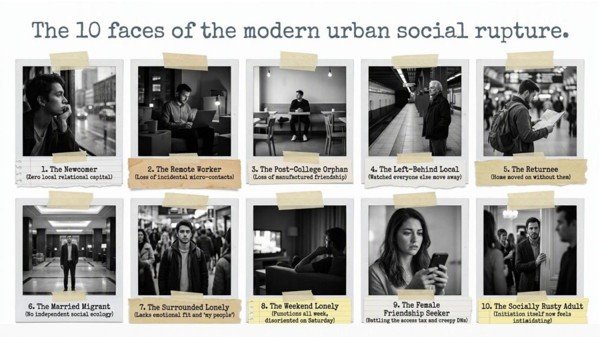
The Married Migrant is usually a woman who relocated for a spouse’s career. “As a woman who recently moved to Coimbatore for husband’s work, I’m left with no friends here.” Her husband has a reason to leave the house every morning. She has a flat and a Wi-Fi password. The marriage-cures-loneliness theory, which Indian families peddle with evangelical conviction, dies on contact with that sentence. Then there’s the Surrounded Lonely, who knows plenty of people and none of them fit, the Weekend Lonely, who functions all week and comes apart on Saturday, the Female Friendship Seeker, paying the screening tax, and the Socially Rusty Adult, disconnected long enough that initiation itself feels intimidating. Stack them up and you see why single-cause explanations fail. A newcomer who works from home and is lonely mainly on weekends is carrying three frictions at once, and fixing any one of them leaves the other two intact.
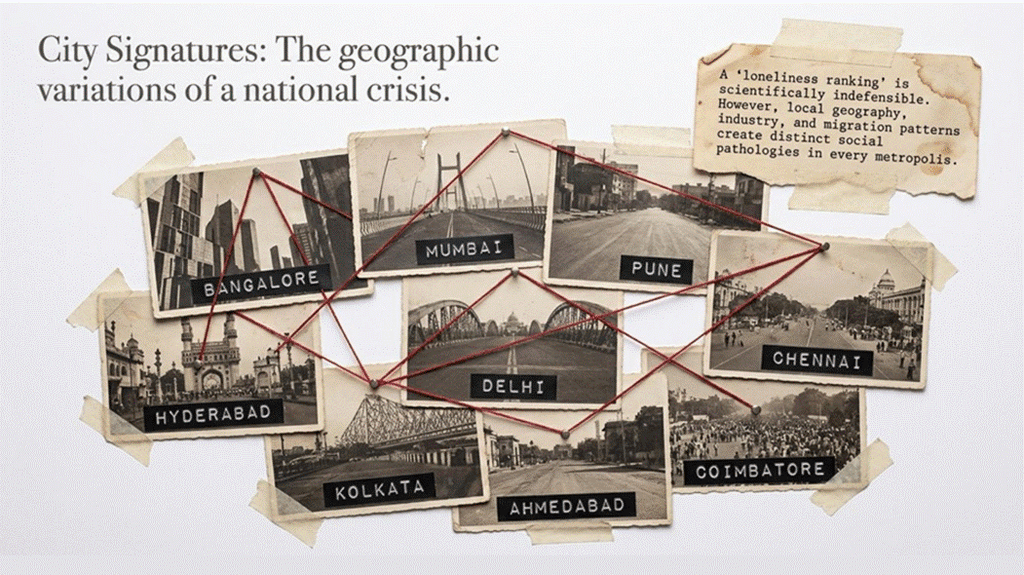
Every city does this differently, which is where the reading gets rich. A loneliness league table is methodologically indefensible, since subreddit size and moderation distort volume. What the threads do reveal are signatures: local geography, industry structure, migration patterns and social norms bending the same underlying problem into distinct local shapes.
Bangalore is opportunity-rich and socially fragmented. It has the most developed ecosystem of clubs and activities in the country, and it still can’t make friendships stick, because the turnover is relentless. People arrive, burn bright on some product team for eighteen months, and leave. The city solves discovery and flunks continuity.
Weekend disorientation appears in 83% of Bangalore’s sampled narratives, the highest of any city. Mumbai, meanwhile, delivers the sharpest version of alone among millions. Brutal work pace, long commutes, workplaces where your colleagues are fifteen years older or already married, and acquaintances who never convert into spontaneous companions. Mumbai’s is a quiet loneliness.
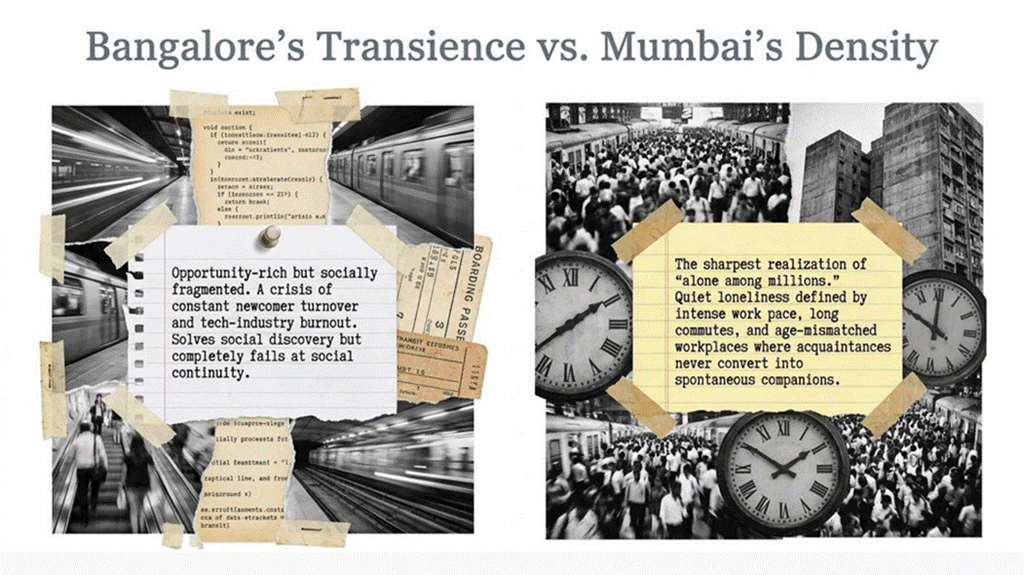
Nobody there is literally isolated. They just have no one to ring for a walk along Carter Road at eight. “I’ve connected with a few fellow Redditors and even went on a trek… but I still haven’t been able to build that genuine connection,” writes the Mumbai introvert with colleagues and no friends.
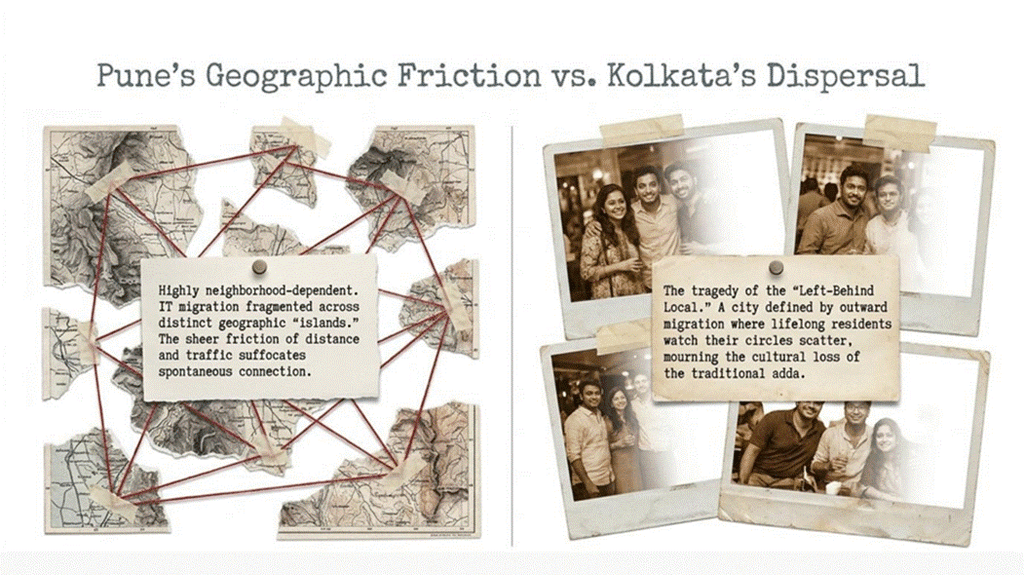
Pune is a city of social islands. Kharadi, Wakad, Hinjewadi, Viman Nagar and Magarpatta behave like separate countries with visa requirements, and travel friction appears in 60% of the Pune sample. Its women say plainly that they prefer small, repeatable gatherings to mass meetups, which, read against that 67%, is a design brief hiding in plain sight.
Kolkata runs the reverse tragedy, a city that exports its young, where the lifelong resident becomes the Left-Behind Local, watching the circle scatter to Bangalore and Toronto. “Most of my old friends are either busy, moved on, or just in a different phase of life now.”
What dies with them is adda, that great Bengali institution of unstructured, argumentative, going-nowhere conversation, and its absence stings harder here than anywhere, because the city remembers exactly what it used to have.
The other five have their own fingerprints. Hyderabad is the collision of IT migration and remote work: WFH isolation shows up in 83% of its sample, and demand became organised enough that moderators built recurring friendship megathreads just to contain the volume. Delhi feels saturated, with newcomers describing residents as locked into school, college and family circles, and women explicitly hunting for female-only groups and sports to dodge unwanted advances.
Chennai’s married and local colleagues retreat into family and old college networks at the weekend, leaving the single migrant outside both, and the counter-mechanism that keeps surfacing is amateur sport. Ahmedabad’s challenge is converting shared space into actual interaction; one poster says everyone “seems locked into their school/college/work circles and breaking into those groups feels impossible.” Coimbatore is the trailing-spouse city, where running clubs, book groups and board-game nights serve as the entry points into a social fabric that otherwise has no door.
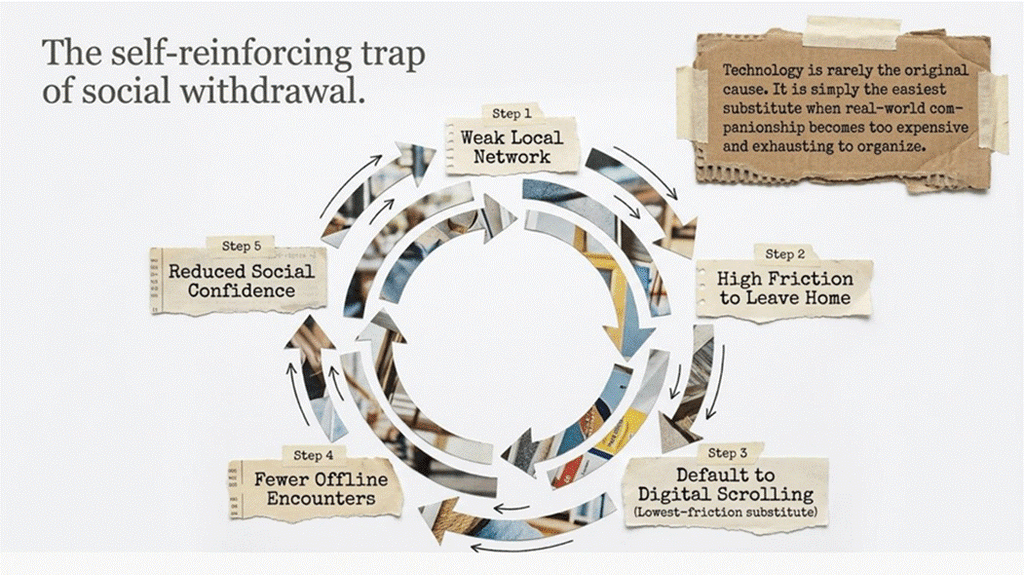
Once a person falls into the gap, a spiral sets in. Weak local network, high friction to leave home, a default to scrolling, fewer offline encounters, reduced social confidence, weaker network, round and round. “Enjoy my isolation a bit too much and now i dont think i can get out of it,” writes someone in Kolkata. From Hyderabad: “For the last 7yrs literally almost every weekend I stayed at home only… now I’m tired of living this way.” Seven years of weekends. Telling this person to just go out more is like advising someone at the bottom of a well to try being taller.
Technology is rarely the original sin in these narratives. The phone slides into the vacuum the city created, less villain than cheapest available substitute. At eight on a Saturday night the real contest is between Netflix and a socially risky, time-expensive, possibly humiliating attempt to build a friendship from nothing. Netflix wins that bout every single time.
And yet. This is where the material stops being a lament. Buried in the comment threads is an informal infrastructure people have quietly built for themselves: running clubs, badminton, Sunday football, board-game cafés, book clubs, treks, karaoke, a Discord server that began as a four-person meetup in Pune. Nobody designed any of it as a loneliness intervention. In practice it’s social scaffolding bolted together by amateurs, and the commenters understand the mechanism better than most startups do. “The current trend is sport clubs. All you have to do is, be consistent,” says someone in Chennai.
From Pune, even more exact: friendship happens when you meet people “thrice a week without any expectations.” Repetition is the intervention. A recurring activity gives strangers a reason to be in the same place again, hands them something to look at other than each other, and lets recognition arrive before intimacy has to.
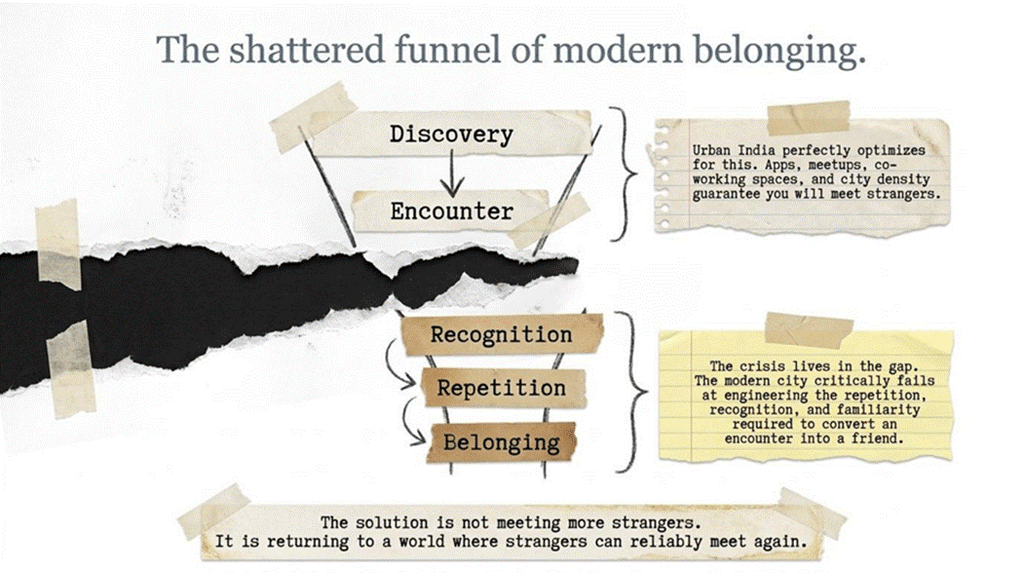
It also explains why one-off meetups disappoint so reliably. A Chennai commenter dismisses them as “mostly 1 timer and not reliable people.” A Hyderabad commenter drops the line that should be printed on the wall of every social-app product team in Koramangala: “You may find good people but not necessarily friends.”
The funnel from stranger to belonging runs discovery, encounter, recognition, repetition, familiarity, trust, friendship, belonging, and it’s shattered right after step two. Urban India is superb at the top of that funnel. Apps, meetups, co-working and sheer density guarantee you’ll meet strangers. Nearly every social product optimises exactly those first two steps, because they’re the ones you can count: sign-ups, matches, RSVPs, headcount. It’s the same disease that ate digital advertising, measuring the click because the click is measurable and quietly ignoring whether anybody bought anything.
The fix sounds simple and is ferociously hard. Optimise for the second meeting and stop worshipping the first. For employers, that means treating hybrid-work design as a social question alongside a productivity one, and building small recurring cross-team rituals in place of the annual offsite with a DJ nobody requested. For housing societies, it means neighbourhood-scale routines, the Sunday walk, the terrace film night, somewhere people can reach in ten minutes in chappals. For organisers, it means small groups, stable hosts, explicit non-dating norms, visible safety rules and a nudge after every event. None of this guarantees friendship. It just rebuilds the conditions under which friendship used to happen by accident. The city is already brilliant at introductions. What it has forgotten is how to let the same strangers meet again.
The demand, once you strip away the apologies, is almost embarrassingly modest. Nobody on these threads wants a thousand followers or a soulmate delivered by algorithm. They want one or two people nearby, a café where the guy behind the counter knows their order, a group that meets again next Saturday. One Pune post from September carries the title “24F in Pune and somehow still looking for my people.” Somehow. That one word holds a lot of failed Saturdays. Her people exist. They’re probably within five kilometres, possibly on the same badminton court on different nights of the week. The whole problem of urban Indian loneliness might come down to getting them onto that court on the same night, three times a week, for a couple of months, until one of them says, casually, as if it were nothing at all, chai after this?