
From dancing babies to dancing pallbearers, what our collective jokes reveal about the years we lived through.
A few days ago, Firefox released an advertisement that did something rather unexpected. It brought back a collection of people who had once been famous for doing things that, by today’s standards, would probably have failed a creative effectiveness test. There was Numa Numa Guy, enthusiastically lip-syncing his way back from 2004. Bad Luck Brian, whose face became a universal unit of misfortune. Tay Zonday of Chocolate Rain, Overly Attached Girlfriend, Success Kid, Annoying Orange and several other veterans of a time when the internet could still make somebody famous for being gloriously, inexplicably themselves.
The commercial, part of Mozilla’s Come Back to Firefox campaign, asks what happened to the internet. Watching it, I found myself asking another question: what happened to us while the internet was happening?
That question is what prompted me to write this. Not because I particularly want to return to the days of buffering video, dreadful website design and the kind of modem that announced its arrival like a small industrial accident. Nor because I think changing browsers will reverse twenty years of platform economics. What caught me was the sight of those familiar faces, older now, standing in for something much larger than their respective jokes. Their awkward performances and accidental fame were once fragments of shared cultural experience. Looking at them in 2026 is rather like opening an old family album, except the family consisted of several hundred million strangers who happened to find the same stupid things funny. Mozilla has made an advertisement about a browser. Somewhere in the middle of it, almost by accident, it has also made an advertisement about cultural memory.

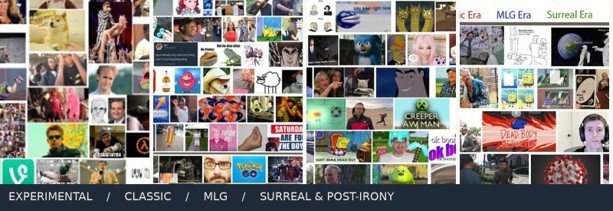
I went down a rabbit hole with a sprawling visual history of memes, from Dancing Baby in the 1990s to the coronavirus, Coffin Dance and Among Us in 2020. I’ve had this image saved since 2021; Finally, now, I’ve written something about it. Thanks Firefox!
Hundreds of tiny pictures, arranged by year, grouped into eras with names such as Experimental, Classic, MLG, Surreal and Post-Irony. Viewed individually, most of these are disposable nonsense. Viewed together, they look uncannily like a diary of the first quarter-century of digital civilisation. Not the diary that governments, economists or technology companies would have written. A far more undignified record of what ordinary people found funny, irritating, frightening, ridiculous, comforting or worth repeating.
The temptation is to treat this as a history of internet humour. I think that misses the more interesting story. A society’s jokes are rarely disconnected from the conditions in which it lives. They borrow their raw material from technology, work, social relationships, politics, aspirations and the particular anxieties of the moment. Which is not to say that the 2008 financial crisis somehow invented Forever Alone, or that Brexit caused Harambe. Culture is not a neatly labelled laboratory experiment. But look at the patterns over time, at the changing form of the jokes as much as their subjects, and something begins to emerge. Memes are not just artefacts of the internet. They are traces of how people learned to experience the world through it.
WHEN THE WEB WAS STILL A PLACE TO GET LOST
The Dancing Baby appeared in 1996, an odd little computer animation that escaped its original technical context and began travelling through email, personal homepages and eventually television. A baby doing a peculiar dance was not, on the face of it, a statement about the triumph of liberal democracy or the impending dot-com boom. Its cultural significance lay partly in the fact that people could encounter this strange thing on a computer and then pass it to other people, who could pass it along again. The delight was as much in the medium as the material. A network had made an improbable, faintly ridiculous object available to strangers who had never met and probably had very little else in common.
The early commercial web was full of that sort of discovery. Personal websites were exercises in aesthetic anarchy. Forums felt like rooms inhabited by people with very specific obsessions. Flash cartoons, mangled video-game translations, dancing rodents and amateur recordings wandered across the emerging web without apparently requiring a business model. All Your Base Are Belong to Us, Badger Badger Badger, Peanut Butter Jelly Time and the Star Wars Kid became familiar references to people whose offline lives might never otherwise have intersected. Their common quality was not polished execution. It was the extraordinary possibility of circulation. Something created for amusement, or in some cases never intended for a public audience at all, could become a shared cultural object.
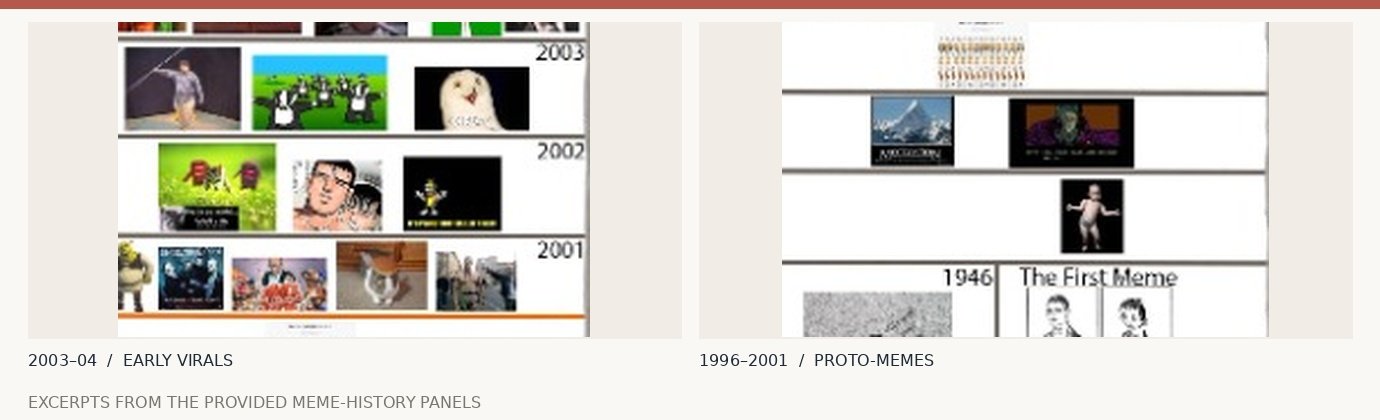
Early-web experiments and proto-memes, excerpted from the supplied chronology.
Gary Brolsma’s Numa Numa, uploaded to Newgrounds in December 2004, feels like the perfect closing scene of this early period. Here was a young man enjoying a song in front of a webcam, with no discernible plan for global cultural relevance. The performance travelled because other people found something delightful in it. That is not the same as saying the early internet was a paradise. It could be exclusionary, vicious and humiliating, particularly when private moments escaped into public view. Star Wars Kid reminds us that accidental virality could be experienced as cruelty rather than opportunity. But there remained a relatively short distance between an individual making something and strangers discovering it. A great deal of the internet’s charm came from the fact that you could not quite predict what you would find or who had made it.
THE JOKE TALKS BACK
Between roughly 2005 and 2013, the internet stopped being a curious place people visited and started becoming an environment they inhabited. YouTube launched. Facebook expanded beyond its original university audience. Twitter appeared. The iPhone arrived in 2007 and slowly helped move the internet out of the study and into pockets, bedrooms, workplaces and dinner tables. In the United States, Pew Research Center found that social-networking use among adults rose from about 7 percent in 2005 to 65 percent by 2015. That is an American statistic, not a universal one, but it captures the scale of the shift. An activity once associated with particular communities was becoming ordinary social infrastructure.
And the memes changed accordingly. LOLcats, Advice Animals and Rage Comics were not simply objects that people watched and forwarded. They were formats that invited participation. You took the photograph, the expression, the familiar character, and inserted something that had happened to you. Trollface supplied a face for provocation. Forever Alone gave social rejection an instantly recognisable silhouette. Bad Luck Brian became a shorthand for the miserable comedy of plans going wrong. These images were primitive in an aesthetic sense, but linguistically rather sophisticated. They took an experience that might have required several sentences to explain and compressed it into a shared visual convention. The internet had begun inventing its own dialects, with syntax, in-jokes, references and a sizeable population of people who understood them without needing a translation
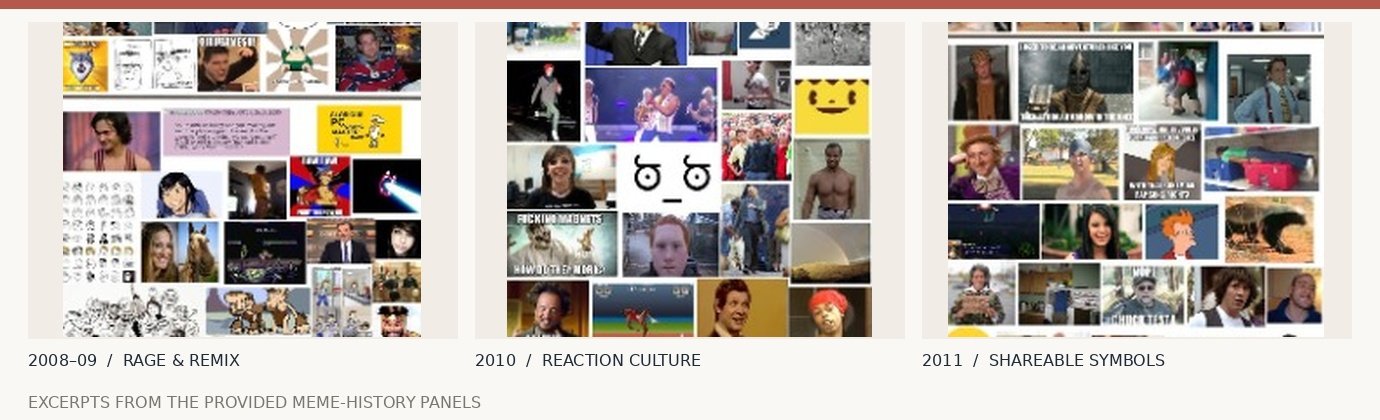
Rage Comics, reaction images and the period when the joke became a reusable template.
Now place that development against the larger decade. The 2008 financial crisis undermined an enormous number of assumptions about prosperity, employment and the competence of institutions. Young people entered economies where educational achievement did not necessarily translate into secure livelihoods. Social networks made everyday comparison more visible, while the smartphone made it harder to step outside that comparison. It would be sloppy history to announce that the recession caused Forever Alone or FAIL culture. People have been laughing at humiliation, bad luck and romantic disappointment since long before anyone thought to put a caption over a photograph. Yet there is something culturally revealing about the emergence of a widely shared visual vocabulary for disappointment, awkwardness, loneliness and the ordinary indignities of being alive.
The joke was becoming a way to say, without quite having to admit it, that things were not going particularly well. It was also a way to discover that other people felt the same. A meme about an unsuccessful job interview, an embarrassing social encounter or the universe’s apparently personal vendetta against you could turn private irritation into communal recognition. This was not merely humour distributed at scale. It was the development of an informal language for emotional experience. Before we were all encouraged to disclose our mental states, cultivate authentic personal brands and publish inspirational accounts of our struggles, the internet had already worked out that a badly drawn face could communicate a distressingly accurate account of an afternoon.
A BILLION PEOPLE SPAWN A BILLION REALITIES
The next turn becomes visible around 2011. As the Arab Spring, Occupy Wall Street and movements against economic inequality unfolded, internet images acquired an increasingly direct political role. The Pepper Spray Cop meme emerged from the November 2011 incident at the University of California, Davis, when police pepper-sprayed seated protesters. The photograph was repeatedly cut out and placed into other scenes, from famous paintings to historical photographs, transforming one officer’s gesture into a portable image of institutional callousness. Here the connection between an event and its meme is not speculative. The image was a response to what had happened, and the subsequent edits became part of how the public interpreted it. Satire had been doing this for centuries; the remarkable change was that the cartoonist had become an uncoordinated crowd.
Yet the same internet that repurposed the imagery of a protest also became obsessed with Nyan Cat, a flying pixelated cat leaving a rainbow trail. There is no contradiction here, unless we insist that every age must have one coherent emotional temperament. People were angry about economic injustice and simultaneously entertained by ludicrous animations. They inhabited political worlds and absurdist ones at the same time. What had changed was the speed with which those different registers could circulate through the same channels. Political participation and aimless play were becoming neighbours in the same feed, though not necessarily experienced in the same way by everybody who used it.
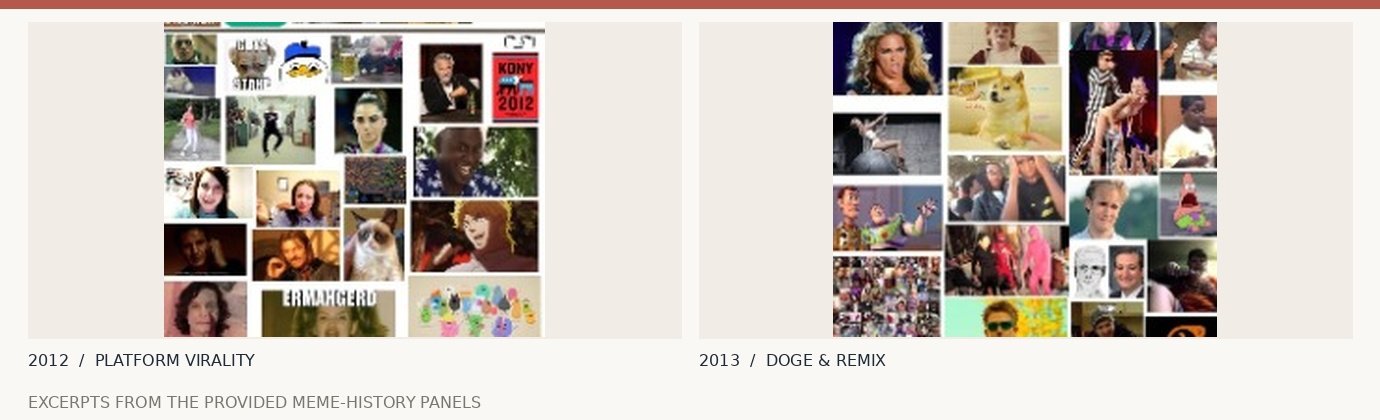
The early 2010s: global circulation, familiar characters and an increasingly shared visual grammar.
Then came Gangnam Style. When PSY’s video crossed one billion YouTube views in December 2012, it demonstrated something more interesting than the world’s appetite for a catchy song and an improbable dance. Korean-language entertainment had become globally reproducible through imitation. Office workers, students and television personalities created their own versions, frequently detached from the original song’s satirical commentary on Seoul’s affluent Gangnam district. What travelled was a recognisable structure: a movement, a rhythm, a performance that others could borrow. The cultural object had crossed borders, but its meaning did not necessarily travel intact.
Doge did something similar at a smaller and stranger scale. The photograph of Kabosu, a Shiba Inu in Japan, developed into a 2013 meme through brightly coloured fragments of deliberately unconventional English. Its innovation was not simply an adorable dog. It was a reusable comic voice, one that could be attached to almost anything. The ordinary rules of language became negotiable, and millions of strangers understood the joke. If Gangnam Style demonstrated that digital culture could travel across linguistic borders, Doge showed that internet communities could also manufacture their own languages within them.
THE ATTENTION MARKET DISCOVERS THE JOKE
By the middle of the 2010s, something about the character of participation had changed. The internet’s amateur sensibility was being professionalised. Vine’s six-second videos encouraged a new economy of timing and immediate recognition. Gaming montages developed an exaggerated visual vocabulary of abrupt cuts, loud sound effects, impossible gestures and deliberate excess. The MLG aesthetic was almost an insult to conventional notions of good taste, which may have been part of its appeal. At the same time, brands, creators and platforms were learning that a repeatable cultural format could also be a repeatable commercial asset. Virality was no longer simply something that happened to a joke. Increasingly, it was something people tried to engineer.
In 2015, an apparently banal photograph of a dress divided the internet into people who saw blue and black and people who saw white and gold. The differences had an identifiable basis in colour perception and assumptions about lighting. Yet The Dress now reads like a wonderfully inadvertent metaphor for the coming decade. Millions of people could look at what seemed to be the same evidence and confidently report different realities. It did not cause political polarisation or reveal anything as grand as the death of objective truth. But it arrived in a media environment increasingly organised around personalised feeds, differentiated audiences and disputes over the authority to describe what was plainly in front of us.
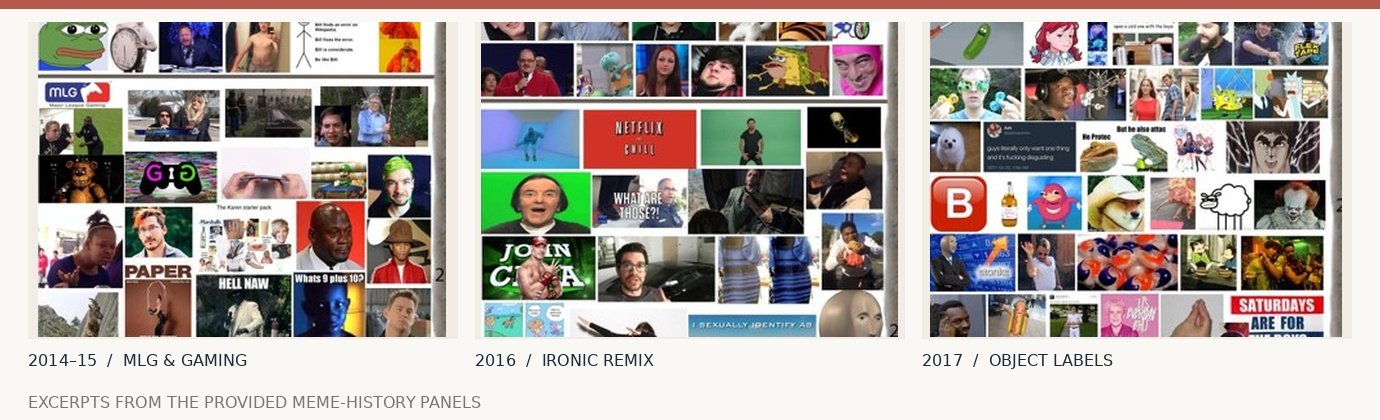
The mid-2010s: gaming edits, layered irony and meme formats for taking a position.
Then 2016 happened, a year that historians will struggle to describe without sounding like they are reviewing a particularly deranged television season. Brexit. Donald Trump’s election. Escalating disputes about migration, identity and institutions. Harambe, Dat Boi, politicised Pepe and ever-deeper layers of internet irony. It would be easy to construct an almost irresistible story in which democratic institutions became increasingly absurd and online humour followed suit. There is enough superficial symmetry to make the essay practically write itself. The problem, of course, is that symmetry is not proof. Harambe’s evolution from an argument about an animal’s death into a seemingly endless joke involved community dynamics, absurdist escalation and the pleasures of collective participation, not simply political despair.
Pepe the Frog offers a harder case because its meanings were actively fought over. Matt Furie’s comic character travelled through ordinary online humour before being appropriated into extremist political contexts; elsewhere, including later in Hong Kong, it acquired different political associations altogether. The character itself had no fixed ideology. Its meaning was made by the communities deploying it. The meme had become a contested political symbol, an inexpensive and remarkably efficient vehicle for expressing allegiance, mockery and antagonism. Memes no longer just represented the news; they were entering the machinery through which the news was framed.
By 2017, Distracted Boyfriend could turn an unremarkable stock photograph into a complete argument. Label the man, his partner and the person passing by, and almost any conflict between loyalty and temptation became instantly legible. The image could represent consumer choice, professional strategy, political hypocrisy or the desire to abandon a difficult task for something more entertaining. This was an important development in the meme as language. It was no longer necessary to share the precise original experience. A template could act as a diagram of thought, allowing strangers to manufacture a miniature argument in a matter of seconds. The internet had not merely accelerated the circulation of opinions. It had invented new instruments for producing them.
WHEN NONSENSE BECAME A REASONABLE RESPONSE
By 2018 and 2019, parts of meme culture had become so self-referential that conventional jokes seemed almost embarrassingly straightforward. Deep-fried images, deliberately degraded graphics, Ugandan Knuckles, Big Chungus and surreal edits encouraged audiences to abandon ordinary expectations of aesthetic quality or coherent meaning. An image could be funny because it was familiar, because it was badly altered, because it referenced several previous jokes or because it was so aggressively meaningless that the absence of meaning became the point. To an outsider, this looked like cultural deterioration. To participants, it often represented a more intricate and exclusive form of cultural literacy.
There are several possible explanations, and we should resist the urge to pick only the most dramatic. An aesthetic arms race among online subcultures is one. When everyone understands a meme, the people who originally enjoyed its insider status invent something more obscure. Cheap editing tools and new gaming environments are another. They made increasingly elaborate manipulation easy. The third explanation is emotional, and therefore harder to demonstrate: that surreal humour offered an appropriate response to information overload, institutional mistrust and a general sense that contemporary reality had become rather difficult to parody by conventional means. When everyday news starts reading like satire, perhaps satire has to become stranger simply to maintain its distance.
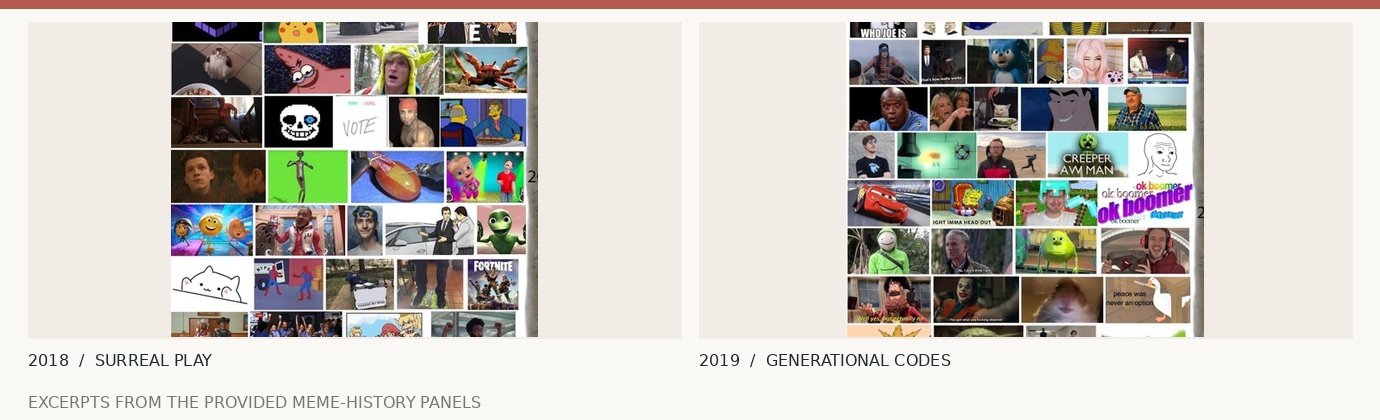
Surreal humour and generational codes, 2018–2019.
Then there was the splendidly economical Woman Yelling at Cat, a composite of a television screenshot from 2011 and a photograph of a cat taken years later. The two images had nothing to do with one another until the internet decided they did. Placed side by side, they captured the asymmetry of an argument: one participant consumed by righteous emotion, the other magnificently unimpressed. It was a small masterpiece of cultural recombination. OK Boomer, meanwhile, compressed an entire generational dispute into two words, acquiring sufficient currency to be used by New Zealand parliamentarian Chlöe Swarbrick during a climate debate in 2019. The phrase did not resolve disagreements about housing, economic opportunity or environmental responsibility. It made those disagreements instantly recognisable, complete with an attitude toward the people perceived to be responsible.
That is perhaps the most revealing characteristic of the late 2010s. The meme increasingly did not need to explain an argument. It needed to establish the position from which an argument could be made. A familiar image or phrase could carry a pre-existing emotional stance, saving participants the effort of constructing it from first principles. This was efficient, inventive and socially bonding, but also potentially reductive. Once a complex disagreement can be replaced by a two-word dismissal, the pleasure of recognition may begin to displace the labour of understanding.
THE YEAR WE WERE ALL INSIDE THE MEME
And then came 2020. Suddenly, the historical relationship between memes and lived circumstances became considerably harder to dismiss as an academic exercise. The pandemic rearranged work, family life, mobility, education and social interaction across much of the planet. People who might ordinarily have occupied vastly different social worlds were dealing with variations of the same restrictions, fears and domestic absurdities. The internet filled with quarantine jokes, badly managed video calls, arguments over toilet paper, pandemic graphs, political performances and the extraordinary shared spectacle of Tiger King. Memes were no longer simply commenting on the strange things happening to somebody else. They were narrating the conditions under which millions of people were living.
The Coffin Dance meme is an almost perfect artefact of the moment, although its source footage of dancing Ghanaian pallbearers predated the pandemic. In 2020, the widely replicated format turned dangerous mistakes and impending disasters into comedy through the sudden appearance of a funeral procession. Its popularity did not require people to find death trivial. Quite the opposite. Gallows humour often depends on recognising the thing everybody is frightened to say aloud. A global public health emergency had made mortality unusually visible, and the internet found a way to make a dance around the edge of that recognition. It was ridiculous, culturally complicated and entirely consistent with the way human beings have always used humour to approach the unbearable.
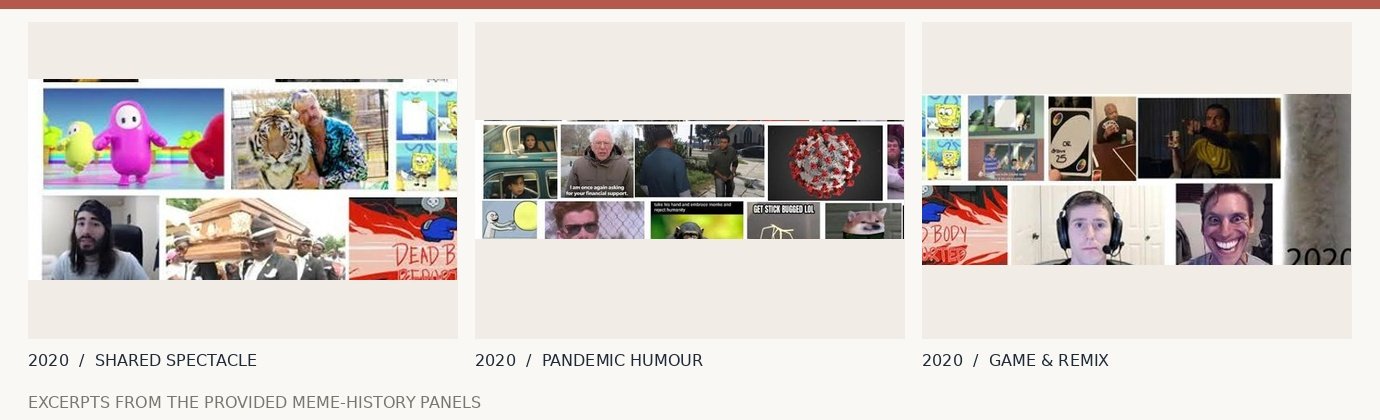
Pandemic-era symbols, games and collective humour, 2020.
For once, we also have research that moves the discussion beyond attractive historical speculation. In an experimental study involving 748 participants, published in 2021, researchers Jessica Gall Myrick, Robin L. Nabi and Nicholas J. Eng examined people’s responses to memes during the pandemic. Exposure to memes was associated with more positive emotional responses than comparison material, while COVID-related memes affected how participants processed pandemic-related stress under the study’s conditions. It would be absurd to announce that memes cured collective anxiety. But the findings support an intuitively familiar proposition: sharing a joke about a common predicament can help people manage how that predicament feels.
The timeline calls 2020 the Post-Irony Era, which is useful provided we do not imagine that irony had somehow vanished. In fact, the characteristic feature of much pandemic humour was the coexistence of irony and sincerity. People could be genuinely frightened while sharing an absurd image. They could laugh at their circumstances without denying the seriousness of those circumstances. The joke became an acknowledgement that normal life had slipped beyond the ordinary boundaries of explanation. If the early internet’s memes had often said, look at this strange thing I found, the memes of 2020 frequently said something closer to you are living through this strange thing too.
WHAT THE JOKES REMEMBER
Looking back across these eras, a tempting narrative presents itself. Innocent play gives way to ironic disappointment, which gives way to political weaponisation, surreal nonsense and finally collective existential crisis. It has all the tidiness of a PowerPoint slide and about the same respect for the complexity of human history. The truth is messier. Early internet communities could be vicious and political. Later internet culture continued to produce affection, sincerity and delight. Surreal memes were not universally popular, and the so-called Classic Era was never equally accessible to everyone. The historical timeline also reflects the biases of the people who assembled and preserved it, particularly an emphasis on English-language platforms and Western meme culture. What happened on Indian-language Facebook, Brazilian forums, Chinese platforms or local messaging networks cannot simply be read off an Anglo-American chart.
What the broader record shows, I think, is the evolution of a cultural language alongside the evolution of the systems in which that language circulated. The early web gave us technological novelty and accidental fame. Social networks turned recognisable images into participatory templates. Political mobilisation demonstrated how those templates could frame public events. Mobile and algorithmic platforms changed the incentives of creation and distribution. Surreal culture expanded the possibilities of irony and insider communication. The pandemic revealed the old, stubbornly human function beneath all that technology: the need to recognise ourselves in the experience of other people.
And that returns me to the Firefox advertisement. It is easy to watch those original meme personalities and experience nostalgia for a supposedly more innocent internet. But perhaps the deeper point is not that the internet used to be better, or even more human. It is that, through these peculiar artefacts, we can actually watch people invent ways of being together in a new environment. We can see curiosity turning into language, language into identity, identity into politics, politics into collective anxiety, and anxiety back into humour. The history of memes is not the history of a succession of jokes. It is the history of the things people found worth recognising in one another as the world around them changed.
Official histories will tell us who won elections, which companies grew, how economies behaved and what technologies were invented. Our memes tell a different, less dignified story. They record the emotional weather of an age, the little acts of imitation and invention through which ordinary people made the large and often incomprehensible developments around them feel shareable. They are not the whole truth about our times. But they preserve something that annual reports, presidential speeches and market forecasts usually fail to capture: what it felt like to live through them.
We did not merely make jokes on the internet. We made a language for living in a world that the internet was changing. And then, without quite noticing, we became part of the joke ourselves.
References and further reading
Mozilla, *Firefox reunites meme royalty* (25 October 2026)
– Computer History Museum, Dancing Baby
– Newgrounds, the story of Numa Numa
– Pew Research Center, Social Media Usage: 2005–2015
– Limor Shifman, *Memes in a Digital World* (2013)
– MIT, *The Visual Life of Occupy Wall Street*
– YouTube, *Gangnam Style Makes YouTube History*
– ALS Association, Ice Bucket Challenge outcomes
– Colour-perception research on The Dress, *Current Biology*
– Meta, *Bringing People Closer Together*, News Feed (2018)
– Chlöe Swarbrick on OK Boomer, *The Guardian*
– Myrick, Nabi & Eng, *Consuming Memes During the COVID Pandemic* (2021)