
What two years of Gurgaon’s subreddits say about ambition, loneliness, the autonomy tax and the islands in between.
THREE YEARS IN GURGAON. A solid job. Office parties, networking events, the full lanyard circuit. “And still have nobody to just call up on a random Sunday morning.” The line sits in an April 2026 thread on r/Gurgaon, and it could pass for the city’s unofficial motto, cross-stitched onto a cushion in every show flat on Golf Course Extension Road.
A chance conversation with an old friend got me thinking about the Gurgaon human condition. “I have split the last year between my flat and my office”, She moaned, “I feel like a fish on a treadmill”.
My friend, who’s moved across countries and could be a bona-fide global citizen – she can’t turn into a miserable transplant, after all. Well, the thesis needed interrogation and that got me doing a forensic analysis of the Gurgaon subreddits.
A word on the evidence, since data gets waved around like a revolver these days. The raw material is a qualitative read of r/Gurgaon and r/Gurugram, with r/gurgaon_meetups tossed in as a side signal, covering roughly October 2024 to September 2026. Reddit is where the young, the newly arrived, the annoyed and the lonely go to think out loud, while the quietly contented residents are off at the clubhouse pool posting nothing at all. Nobody writes “moved to Gurgaon six months ago, everything is basically fine.” So treat what follows as a stethoscope pressed against a chest. The heartbeat is real. The sample is skewed. Onward.
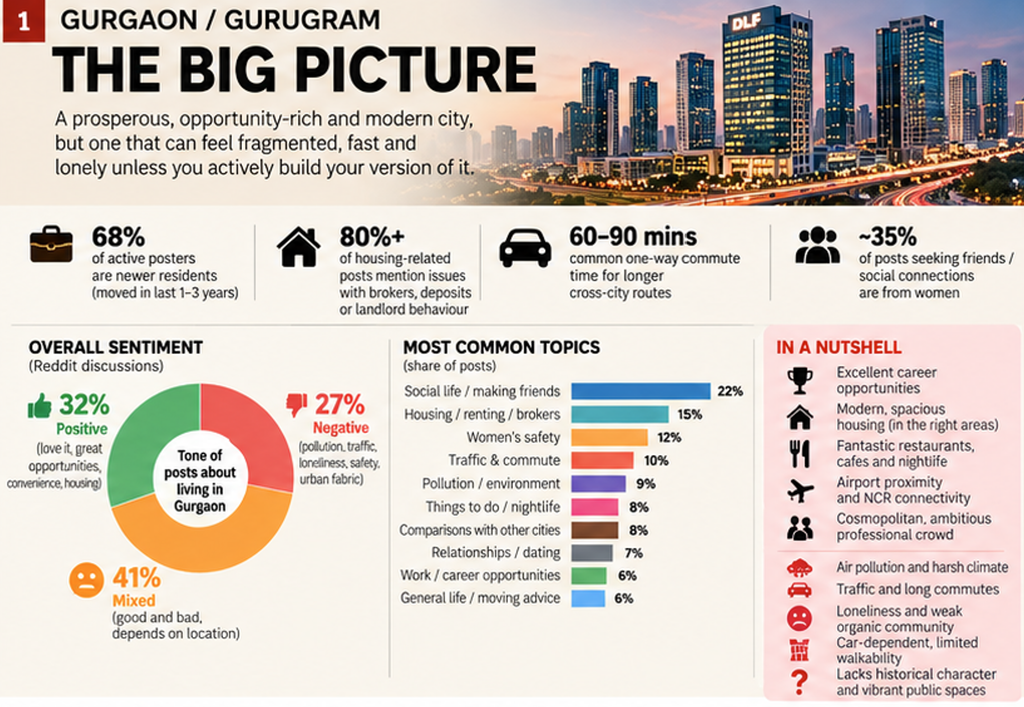
The first thing the stethoscope picks up is an archipelago.
There’s the condominium island, with its biometric gate and its infinity pool that nobody swims in after October. There’s the office island, a glass tower with a food court that could feed a small Baltic nation. There’s Galleria, and Cyber Hub, and 32nd Avenue, and the airport corridor, and Delhi floating off to the north like a mainland you visit for your parents and your parathas. Each island works. Some of them work beautifully. And in the 800 metres between any two of them, the city simply stops trying. The footpath ends in a construction pit. A Fortuner comes at you the wrong way down a service lane. A cow regards you with the serene contempt of an animal that has outlived three master plans.
One newcomer called it a “concrete jungle” and moaned about the dust and the cab dependence and the absence of any culture beyond corporate life and partying. Another long-time resident, in a post that pulled more than 600 upvotes, described years of what he called home to office, office to home, and admitted he’d never grown much of an emotional attachment to the place. Six hundred people pressed the little arrow to say yes, me too. That’s a congregation.
A Delhi transplant who moved over after marriage put it without any poetry at all, which is what made it land: everything is so spread out, and “even short distances sometimes feel far.” Half a century of urban planning theory, compressed into one weary sentence. Distance in Gurgaon has very little to do with kilometres. It’s measured in friction. How many U-turns, how many potholes, how much surge pricing, how much of your will to live you spend getting from a nice place to another nice place.
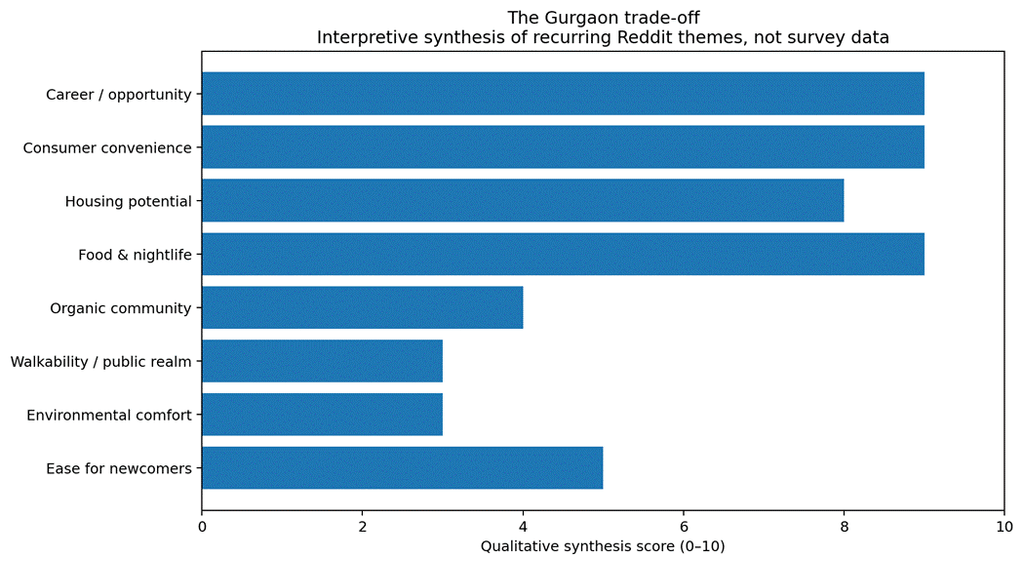
EXHIBIT 1 The Gurgaon trade-off. Interpretive synthesis of recurring themes across r/Gurgaon and r/Gurugram. Scores are editorial and qualitative, not survey measurements.
And yet, and this matters, the same threads carry a stubborn counter-narrative. One resident who had lived in Gurgaon, Delhi, Bangalore, Mumbai and Pune went out of their way to praise the modern housing and the price-to-quality ratio. Mumbai migrants in particular walk into a Gurgaon flat and feel the ceiling lift off their lungs. Enormous consumer choice. Restaurants that would hold their own anywhere. An airport you can reach before your podcast finishes. So I can’t honestly call Gurgaon unpleasant. I’d call it violently micro-location-dependent, which is a clumsier phrase and a truer one.
The practical consequence is savage. Two people on identical salaries can live in completely different cities. One has a ten-minute commute, a decent society, a gym and a couple of friends within a radius you could walk if walking were legal. The other does a cross-city crawl every morning and comes home to a flat that’s lovely inside and surrounded by nothing. A woman on the sub asked about commuting from Sector 91 to Saket and was told, more or less, that the geography itself was the problem. Somebody who’d lived in Sector 91 chimed in that it felt extremely far from everything. The offer letters carry the same pin code and describe different planets. If I were moving there tomorrow I wouldn’t ask whether Gurgaon is nice. I’d ask what my three-to-five kilometre Gurgaon looks like, and I’d draw that circle on a map before I signed anything.
I keep thinking about how cities used to make friends for you. You didn’t have to try. Where I sit now, on the Northeast’s doorstep, and in the Calcutta I grew up adoring from a distance, the adda did the work. You showed up at the same tea stall, or the same para corner, for long enough, and one day somebody who’d been arguing about Satyajit Ray or Mohun Bagan simply turned to you and pulled you into the argument. That was friendship. Repetition plus proximity plus nobody being in a hurry. Old Delhi had its galis. Bombay had the 8:14 fast local, where you could spend eleven years standing next to the same guy and end up dancing at his daughter’s wedding. Gurgaon has office parties.
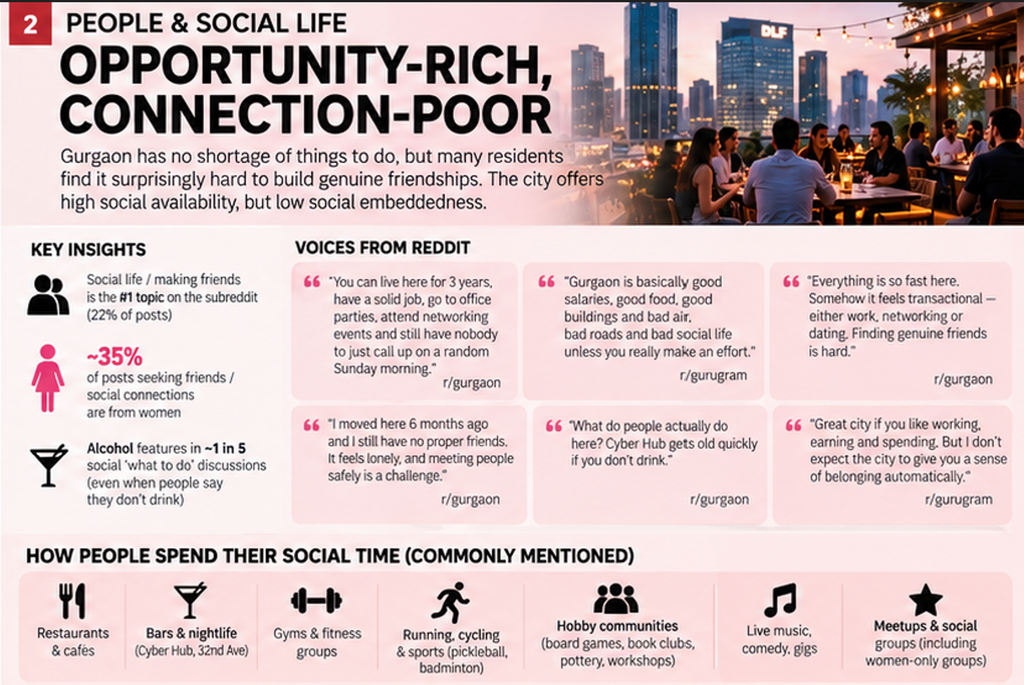
The threads circle something else, like a moth around a tubelight. I went in expecting traffic and pollution to top the grievance charts. They didn’t. Loneliness did. There are so many posts about loneliness on these subs that people have started posting about the number of posts about loneliness (meta and sad in roughly equal parts). A June 2026 thread asked outright why everyone in Gurgaon is so lonely, after the poster noticed an endless procession of strangers asking for company for a movie, a cup of tea, a drive. It crossed 200 upvotes. A woman posted that after six months in the city she still had no proper friends. Someone else described weekends spent entirely alone after moving for work. And a former Bangalorean, with the dry wit of the recently displaced, joked that Gurgaon seemed to run “12 out of 10 posts every single day” about making friends.
Several commenters pushed back, correctly, that migrant professionals everywhere go through this. Hyderabad has lonely people. So does Whitefield. But Gurgaon has a few features that seem to crank the volume. A gigantic transplanted workforce. Long hours. Homes and offices sitting in separate zip codes of the soul. Neighbourhoods where going for a walk is a slightly eccentric act. Colleagues who stay colleagues, then switch jobs, then switch cities. And a social scene where most of the visible gathering spaces charge an entry fee or a cover.
I’ve started calling it high availability, low embeddedness. Everyone’s reachable. Nobody’s rooted. There are thousands of people in that city who would dearly like one more friend, and the machinery that turns two such people into actual friends is surprisingly rusty. The city built enormous infrastructure for a lifestyle and forgot, somewhere between the DLF brochure and the ribbon cutting, to build any infrastructure for belonging. Belonging, in Gurgaon, is bring-your-own. Like the wine at a Delhi dinner party where the host is pretending they forgot to buy it.
A newcomer comparing the place with Bangalore asked a question that should be printed on a hoarding at IFFCO Chowk: “How do you guys have fun actually without alcohol here?”
Somebody arriving from Mumbai asked much the same thing, said they were struggling to feel the vibe. The top-voted reply joked that people here drink cheap single malt and complain about infrastructure. When the poster admitted they didn’t drink, the gist of the response was, well, good luck then. A newcomer from Chennai went further and described a proper culture shock: the speed, the money on display, the partying and drinking and smoking, the peer pressure, the gnawing feeling of not fitting anywhere. The non-drinkers in the replies recognised themselves instantly. One Bangalore-versus-Gurgaon thread produced a portrait of the city so absurd it read like a Hunter S. Thompson grocery list: weather, airport, dust, floods, AQI, food, cars, alcohol, alcohol, alcohol.
Nobody’s claiming everyone in Gurgaon drinks. Obviously not. But alcohol occupies an outsized place in how the city describes itself to itself, and residents are the first to make the joke. The visible social layer, the one you see from the cab, the one Instagram serves you, is basically alcohol wearing a nice shirt. Rooftop bars. Microbreweries. Ladies’ nights. Sundowners that start at four. If you don’t drink, or you’re done drinking, or you simply want a Saturday that doesn’t end with a shawarma in a parking lot at 2 a.m., the city can feel astonishingly narrow for its size.
And yet. Scroll further down that same thread and a resident replies, a little exasperated, a little kind: Gurgaon has all of those things and more, “you need to look beyond the obvious here.” The resident has a point. There’s a second Gurgaon underneath the first one. Running clubs that meet at 5:30 a.m. before the air turns to soup. Cycling groups. Pickleball, which has colonised the city’s courts like a benign fungus. Badminton, pottery, board game nights in cafés with terrible names, book clubs that read one book in four months and mostly talk about their managers. It exists. The catch is you have to go digging with your own hands, because nothing about the city’s layout will ever deliver you there by accident.
Gurgaon is thick with activities and thin on communities. Those are two different animals, and confusing them is how you end up with a packed calendar and an empty phone. The city rewards affiliation that you actively chase. Simply being present, the thing that worked for every migrant generation before this one, gets you nothing here except a higher electricity bill.
Then there’s the other city. The one women live in.
I want to be careful here, because the lazy version of this conversation collapses into “is Gurgaon safe, yes or no,” and the women on these subreddits are saying something far more interesting than that. Their recurring issue is the mental overhead. The constant, low-grade, background computation of risk. Which sector to rent in. Whether that bus route is okay. Whether you can walk after dark. Which clubs feel comfortable and which have a reputation. Cab or colleague. How late is too late. Which stretches to skip entirely. The questions themselves are the data. Men don’t post them.
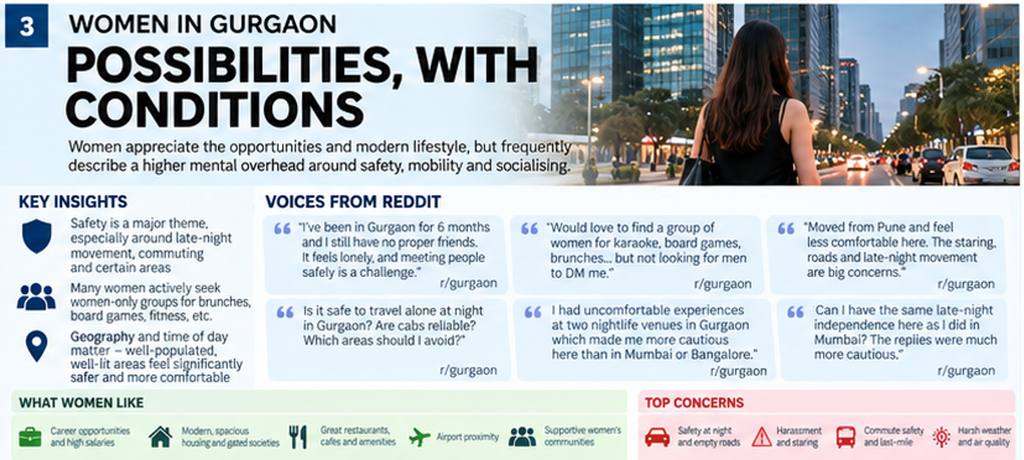
One woman moving from Mumbai had grown up there, lived there her whole life, used to late nights “without an ounce of fear in my body.” Then the question: would she be able to live the same way in Gurgaon? The replies were noticeably more cautious, especially about deserted roads and moving around late. A 24-year-old who’d come from Pune described being stared at, difficult roads, an everyday life that felt dramatically less comfortable. Another woman described feeling unsafe during incidents at two Gurgaon nightlife venues and said those experiences left her more open to strangers in Mumbai or Bangalore than here.
The honest answer the threads offer is complicated and mostly unhelpful to somebody standing in a Bandra flat with packed cartons. She can live independently in Gurgaon. Thousands of women do, brilliantly, running teams and companies and their own lives. But her independence will be conditional in a way it wasn’t in Mumbai. Conditional on geography, on transport, on the hour of the night, on which island she’s standing on and how she gets to the next one. The city charges women an autonomy tax, collected in small daily denominations of vigilance, and nobody ever prints the receipt.
Jane Jacobs wrote, sixty-odd years ago, about eyes on the street: the shopkeepers and vendors and loiterers and old aunties at windows whose sheer presence keeps a street safe without anyone deciding to keep it safe. Gurgaon was built, in large parts, without them. Enormous roads. Gated developments turned inward. Vacant plots. Office districts that go dark at seven. Footpaths that start and stop like a bad stammer. At two in the afternoon, all of that is merely inconvenient. At midnight, it changes how your body feels walking to the gate. One discussion on the sub made exactly this link, between car dependency, thin pedestrian life and internal sector roads that go empty at night. So Gurgaon’s safety problem is partly a policing problem and partly an urbanism problem, and the second half almost never gets said out loud.
What the women on these subs have built in response is quietly impressive. They’re anything but withdrawn. There are posts all over the place looking for brunch companions, coffee friends, board game partners, karaoke crews, picnic people. A 23-year-old newcomer asked how to find other women for karaoke and board games and brunches, and made it crystal clear she did not want men sliding into her DMs. One proposed friendship group laid down its terms like a constitution: first meetings in groups, real names and photos, women’s comfort as a non-negotiable condition. Trust infrastructure, essentially. The stuff the city should have provided and didn’t, so the residents stitched it together themselves out of WhatsApp groups and common sense. Heartbreaking and heroic in roughly equal measure.
That’s also why I won’t over-read r/gurgaon_meetups. A meetup sub will naturally exaggerate the looking-for-people phenomenon, and it comes with its own selection effects around dating. But the loneliness is already sitting in plain sight on the main subreddits without it. The meetup community reads better as a response to the condition, the antibody the city’s immune system produced on its own.
There’s an asymmetry buried in all this. Men and women on these subs are both lonely. Their posts just carry different payloads. A typical male post says, in effect: I don’t know anybody, how do I meet people? A typical female post says: I don’t know anybody, how do I meet people safely, and without the whole thing turning romantic or sexual? That one extra clause carries a tonnage the men’s posts never have to lift. It turns the city’s social marketplace into a strange mismatched bazaar, full of men wanting contact and women wanting contact, where the two needs don’t automatically click because one side has to keep checking whether friendship is actually friendship.
And the dating culture gets tangled up in the loneliness. People on the threads complain that attempts at plain friendship keep drifting into one of two ditches, networking or romance. You meet someone at a board game night and within three weeks they’ve either asked for your LinkedIn or asked you out. That, I suspect, is a very particular signature of a young, career-obsessed migrant city, where every human interaction has been gently trained to have a deliverable.
Meanwhile the physical city fights you on its own schedule.
Credit where it’s owed. The housing stock is genuinely good. Furnished rooms, 1RKs, gated communities, high-spec flats, the lot. People arrive and suddenly have a balcony, a clubhouse, a gym, space. For many, the flat alone is why they stay. The market wrapped around the flat is a different creature entirely. One woman described a broker who raised his brokerage after seeing her salary slip, which is the kind of detail you couldn’t invent if you tried. Another poster rang more than 100 landlords and came back with an anthropology of mutual suspicion: vacancies, brokerage, deposits that behave like ransom, and distrust flowing in both directions. Things got bad enough that the subreddit itself set up dedicated rental and flatmate threads, with rules forcing brokers to identify themselves. Excellent product, wretched systems. If Gurgaon has a single defining contradiction, that’s probably it, and it repeats at every scale.
A newcomer six months in wrote what I’d call the definitive Gurgaon onboarding document. First came the steep cost of living, the traffic and the pollution. “Then came summers and the electricity and water woes.” And then the monsoon arrived, and it turned out, in his words, that the city’s drainage system was “non-existent.” You could chart the Gurgaon calendar year by whatever is trying to kill you this month. Winter, the air. Summer, the heat and the power cuts. Monsoon, the water rising in the underpass until a news channel sends a reporter to stand knee-deep in it looking concerned.
These aren’t aesthetic whinges. The weather and the air and the broken footpaths decide whether you walk, whether you linger outside, whether you ever bump into your neighbour at the sabziwala’s cart. When a city makes being outdoors hostile for half the year, people retreat into cars and flats and malls. The islands drift further apart. The loneliness compounds. Everything’s connected, a sentence I’d usually mock, except here it happens to be literally true.
People, it turns out, aren’t reviewing Gurgaon. They’re reviewing whatever Gurgaon replaced.
PEOPLE ARRIVE WITH LUGGAGE AND BAGGAGE
Everybody arrives carrying a baseline, the city they came from, stuffed into the luggage next to the pressure cooker. Gurgaon gets experienced as a delta from that baseline, never as a thing in itself.
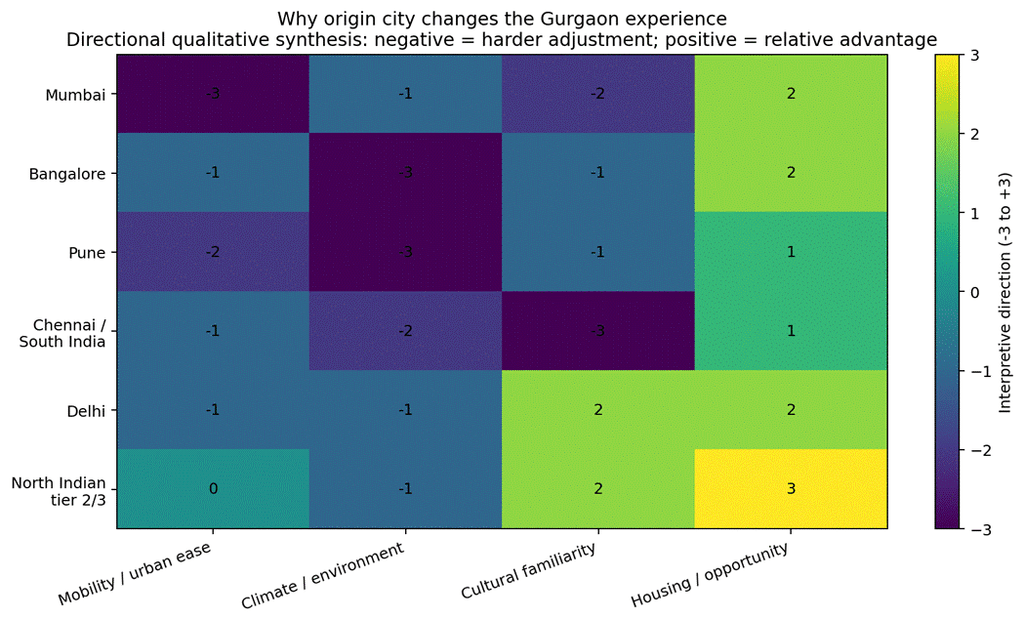
EXHIBIT 2 Why origin city changes the Gurgaon experience. Negative values mark a harder adjustment, positive values a relative advantage. Directional synthesis, not survey data.
Mumbai to Gurgaon produces maybe the sharpest everyday downgrade. Mumbaikars are used to walking, trains, mixed-use neighbourhoods, a city that moves on foot at 1 a.m. and keeps its own hours. Gurgaon feels fragmented to them, car-shaped. The funny twist is that work can run the other way: one person who’d worked in both found Gurgaon a touch more relaxed professionally than Mumbai’s permanently caffeinated grind. So Mumbai migrants aren’t rejecting Gurgaon’s economy. They’re mourning Mumbai as an organism.
Bangalore to Gurgaon is a different grief. Bangaloreans clock the weather and the trees and the air within a week, and those are fights Gurgaon will never win. One Bangalore migrant found the dry heat a genuine ordeal. Another thread singled out NCR air quality as the dealbreaker. “You will miss those breweries,” one poster warned, while conceding the weather is worse but “traffic is better,” and that people are “different both in a good and bad way.” Gurgaon claws back points on nightlife, the airport, North India access, housing space, places that stay open late, and sometimes, depending on your commute, even traffic. One resident who’d lived both lives flat-out preferred Gurgaon for the food, the people, the airport, the healthcare. There’s a quieter asymmetry too. Somebody leaving Bangalore after twenty years isn’t leaving a city, they’re leaving a network. They’re comparing a brand-new Gurgaon with a fully furnished Bangalore, which is wildly unfair and psychologically unavoidable.
Pune to Gurgaon seems to deliver the rawest quality-of-life shock, especially for women. Pollution, weather, road manners, ease of just getting around. Gurgaon residents flirting with a move to Pune talk dreamily about the cleaner air, then worry about losing NCR family and friends.
Chennai and the rest of the south bring the deepest cultural adjustment. A recent Chennai migrant said the work style and daily routine felt markedly different, and that for a long time every single relationship stayed inside the office. The broader south-to-north threads keep mentioning volume, directness, personal space, a perceived aggression. Those are perceptions, subjective, and I’d never pin them on a population. But they explain why some southern arrivals experience Gurgaon as a louder, pushier room.
Delhi to Gurgaon hardly counts as migration at all. It’s a change of urban form. Delhiwallahs grumble that Gurgaon is spread out and pricey, that the street food is worse, that there’s none of the neighbourhood texture that took Delhi four centuries to marinate. One of them summarised the whole grievance with the economy of a telegram: “Delhi ka khana is better and cheaper. Distance. Costly.” Yet the trade can be ruthlessly rational. One Delhi-to-Gurgaon account estimated saving 1.5 to 2 hours a day on the commute, and loved the newer flats, while still pining for Delhi’s food. For Delhi people, Gurgaon is Delhi with the history sanded off and rebuilt around offices, condos and cars.
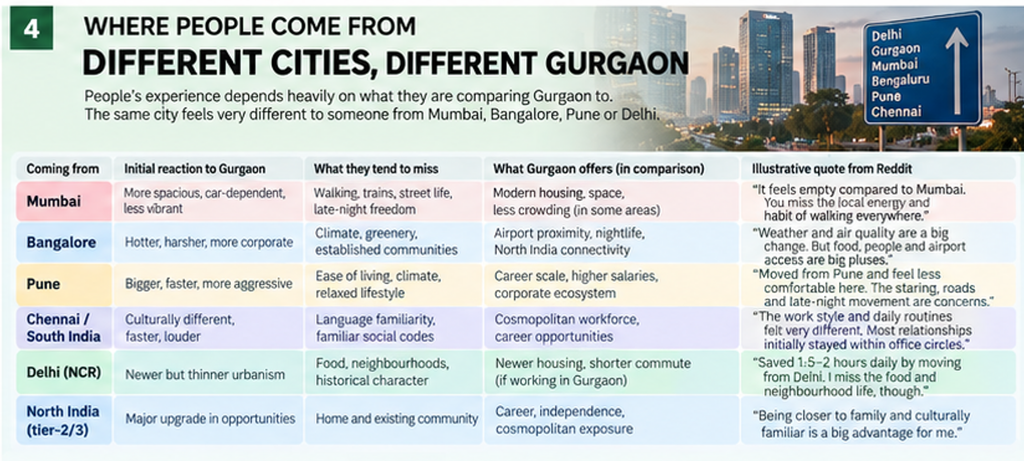
THE ORIGIN-CITY MATRIX
| COMING FROM | GURGAON FIRST FEELS | WHAT GETS MISSED | WHAT COMPENSATES |
| Mumbai | Fragmented, car-dependent, spacious | Walking, trains, street life, late-night freedom | Housing, space, corporate opportunity |
| Bangalore | Hotter, harsher, louder, more corporate | Weather, greenery, established networks | Airport, NCR access, nightlife, housing |
| Pune | Bigger, faster, more aggressive | Ease, climate, relaxed rhythm | Career scale, salaries, corporate ecosystem |
| Chennai / South | Culturally discontinuous | Language, familiar social codes | Cosmopolitan workforce, NCR opportunity |
| Delhi | Newer but thinner urbanism | Food, history, neighbourhood texture | Shorter commute, new housing, gated amenities |
| North Indian tier 2/3 | A big upgrade in opportunity | Home and community | Career, independence, proximity to home |
| Punjab / Haryana / UK / HP | More culturally legible | Family and support system | Far easier trips home than southern metros |
| Returning NRI (hunch) | Chaotic but wildly convenient | Order, clean air, public realm | Domestic help, delivery economy, housing |
EXHIBIT 3 What each arrival loses and gains. The last two rows are hypotheses suggested by the threads, not strongly evidenced findings.
And then there’s the group the metro snobs always forget.
For someone from a North Indian tier-2 or tier-3 town, a Hisar, a Meerut, a Bareilly, a Karnal, Gurgaon isn’t a downgrade from anything. It’s the whole promise. It’s the salary that funds a sister’s education. It’s the first flat with your name on the lease, the first time you ordered sushi and pretended you’d had it before, the freedom of being anonymous after a life lived under the magnifying glass of a mohalla that knew what you ate for breakfast. For people from Punjab, Haryana, Uttarakhand, UP, Himachal, add the language and food that feel like home, parents a few hours away, and the mountains close enough for a long weekend. A woman weighing a move from Bangalore to Gurgaon cited exactly this, being near family and culturally closer to Punjab. An Uttarakhand native stuck between the two cities counted proximity to home as Gurgaon’s trump card.
Look at the inversion. A Bangalore native sees worse air, worse weather, fewer trees and an aggressive city. Someone from Dehradun working in Bangalore sees family, familiar food, the hills, Delhi airport and a place that finally speaks their language. Same city. Completely different utility function. I suspect the returning NRI sits in yet another column, finding the place chaotic and yet absurdly convenient, trading clean air and order for domestic help and a delivery economy that would make a Londoner weep. That last group needs more evidence before I’d bet on it, so file it under hunch.
Everyone is grading the same object against a different answer key, and that principle travels a long way beyond one city in Haryana.
Read the newcomer posts side by side and a standard adjustment curve emerges, so reliable you could set your watch by it. It starts with shock, a sort of what-the-hell-is-this phase, where the heat or the cold, the dust, the AQI and the driving etiquette (or its total absence) dominate everything. Somebody on a newcomer thread offered the most Gurgaon reassurance imaginable: the city “can make you feel a bit isolating but eventually you’ll discover its chaotic charm.” Another replied with the weary empathy of a veteran: “Can relate to this, here everything is so fast.” Then comes work absorption, when the office quietly becomes your entire social universe and home-office-home becomes a loop you run like a hamster with a corporate ID card. After that, the weekend vacuum. The malls lose their shine, you’ve been to every brewery on Cyber Hub twice, and one Saturday you’re sitting in a beautifully furnished flat realising you have nowhere to be and nobody to be there with.
That’s the fork. Some people leave. Some just endure. And some do what the successful adapters keep describing, which is to deliberately construct a life. They join a running group, a cricket team, a salsa class, a Sunday cooking club. They build a neighbourhood routine, the same café, the same kirana uncle, the same evening walk, until the anonymous city grows a few familiar faces. Eventually they arrive at a personal Gurgaon: a curated set of nodes, home and work and friends and favourite haunts, with Delhi as an extended cultural backyard. It’s never one continuous urban experience. It’s a playlist. But it’s theirs. Gurgaon, it turns out, disproportionately rewards the proactive. Waiting around to be absorbed is a strategy that simply doesn’t work here.
The likeliest explanation for all this is also the one I hold most loosely.
Most great Indian cities existed before their current economies. Delhi was Delhi long before the ministries and the malls. Mumbai’s identity overflows finance and Bollywood. Kolkata exists stubbornly, almost defiantly, independent of whatever its labour market is doing this decade. Modern Gurgaon is different. Corporate employment, real estate, migration, consumption and aspiration aren’t things happening inside the city. They made the city. So its founding archetypes are the office tower, the condo, the mall, the bar, the gym and the expressway, where older cities got the bazaar, the university quarter, the maidan, the promenade and the crooked old residential lane. People call it culturally empty all the time on Reddit. I don’t buy that. It reads to me like a young city whose culture hasn’t yet peeled itself away from the economic machinery that gave birth to it. Give it time. Give it a few generations of kids who grew up there and have no other baseline. Culture is mostly just memory that got old enough to be shared.
The psychological consequence, in the meantime, is a contradiction you can feel in almost every thread. You can buy almost anything. You can find almost any cuisine. You can earn extremely well. You can live in a spectacular apartment. And you can still wonder where everyone is on Sunday morning.
Reduced to an equation, always a slightly vulgar thing to do to human beings, the corpus looks roughly like this.
GURGAON EXPERIENCE ≈ origin-city expectations × life stage × micro-location × commute × existing social network × gender × drinking/social preferences × family geography
Life stage might matter as much as origin. A single 24-year-old who lands from Bangalore knowing nobody lives in a lonely, polluted, alcohol-soaked Gurgaon. A 38-year-old couple with two kids arriving from Mumbai sees a 2,000-square-foot flat, a clubhouse, a pool, domestic help, decent schools, the airport and a fifteen-minute commute, and concludes they’ve upgraded their entire existence. A North Indian professional in their thirties who’s spent a decade in Bangalore suddenly finds that being a few hours from ageing parents outweighs the weather and the breweries combined. The city stays exactly as broken and exactly as useful. The person looking at it moves.
Asking whether Gurgaon is a good city is the wrong question. It was always the wrong question. The useful one is whether a particular Gurgaon, a specific island chain assembled by a specific person, fits the person living in it. Pick the wrong sector, accept a sixty-minute commute, know nobody nearby, expect the city to hand you a social life, and you’ll get exactly the alienating Gurgaon those threads keep describing. Pick a walkable-ish pocket, keep work close, build two or three communities that have nothing to do with your job, treat Delhi as your cultural hinterland, and settle into a neighbourhood routine, and you could be describing an entirely different place. For women, add one more lever and weight it heavier than the rest. Micro-location. A well-populated, well-lit, connected neighbourhood trims more than commute time. It turns down the constant hum of the safety calculator running in the back of your head.
Gurgaon will give you a lifestyle almost automatically. It will not give you belonging. It never promised to. The brochures promised infinity pools and 24-hour power backup, and to be fair, mostly delivered. Nobody printed “a friend to call on Sunday morning” in the amenities list, because nobody in the building trade knows how to pour that particular concrete.
That part you pour yourself. Slowly. Over months of showing up to the same 5:30 a.m. run, the same terrible board game café, the same WhatsApp group that’s ninety percent good-morning forwards and ten percent actual humans. It’s tiring. It’s unfair, frankly, that a city this rich makes you work this hard for something a Calcutta tea stall hands out for free.
But the people who do the work end up living in a different Gurgaon from the people who wait for the city to do it for them. I find that oddly hopeful. Somewhere in the Sector 56 night, the person who wrote that Sunday-morning post is maybe, possibly, one running club away from a phone that rings.
I hope it rings.