
A working theory of how things actually change. And why they mostly don’t.
Here’s something that will bother you once you see it. You cannot unsee it after. Trends, the things that marketing consultants build entire careers narrating, the things that get announced at Davos and decoded in quarterly brand reports and turned into keynote slides with too many gradients, behave exactly like physical forces. Not as analogy. Not as poetic device. As operational, diagnostic, infuriatingly literal reality.
Newton didn’t invent gravity. He named something that had been dropping apples and steering planets long before he sat under that tree. That’s the only ambition here. The physics was already running. We just kept calling it disruption, paradigm shift, sea change, and other words that sound like insight but function like a blindfold with good branding.
I came to this through frustration, honestly. Twenty-something years watching brands chase trends they didn’t understand, misreading force events as causes when they were always just triggers, declaring the death of things that hadn’t even flinched. The funeral for television. The funeral for cash. The funeral for the office. The funeral for physical retail. The corpses kept sitting up. Nobody asked why. They just scheduled another funeral.
The Newton analogy earns its keep not because it’s elegant, though it is, but because it forces precision. And precision is the thing trend discourse is most desperately, structurally allergic to.
Watch a video instead.
Before the three laws get their full treatment in subsequent essays, let me put the complete architecture on the table. Consider this the operating manual. The thing you read before you start touching things.
The First Law is about rest states. Any cultural, behavioural, or market condition persists in its current form and direction until a sufficient constellation of forces produces irreversible structural change. Persistence is not passivity. Say that again slowly. The rest state is not sleeping. It is actively resisting. It has mass. That mass varies. And inertia is not the absence of force. It is the presence of a force strong enough to defeat everything currently pushing against it.
The Second Law is about what actually moves things. No single force changes a rest state. Not one. Ever. Change requires a constellation, multiple forces achieving simultaneous critical density, where each alone would be insufficient. Force events are triggers, not causes. The cause is always systemic, always distributed, always assembled over time in the dark before the visible moment of ignition. The loudest signal is almost never the actual story.
The Third Law is about what happens after. Every significant change generates a reaction. But not simply equal and opposite. The reaction occupies a field, and within that field three distinct types operate with completely different strategic implications. Mirror reactions. Displacement reactions. Synthesis reactions. The third type is where things get genuinely strange and genuinely valuable.
—
On the Analogy’s Limits. And Why We’re Using It Anyway.
Classical mechanics assumes clean separability. Force acts on object, object responds, cause precedes effect in a tidy queue. Trends don’t respect that queue. They never have.
The Internet caused e-commerce which caused the collapse of physical retail which caused urban real estate restructuring which is currently causing a fundamental rethink of what cities are actually for. 9/11 was caused by a specific political history that stretches back decades and then became a cause of the surveillance state, the transformation of global travel, the architecture of paranoia that now lines every airport in the world, and an entire generation’s foundational distrust of institutions they were raised to believe were trustworthy. Smartphones caused the selfie caused Instagram caused influencer culture caused an adolescent mental health crisis severe enough that governments are now legislating against the phones that caused the selfie that caused Instagram. Each effect becomes a cause. The chain has no clean beginning.
What looks like a beginning is always already a middle. What looks like a cause was already someone else’s effect.
This bidirectionality is real and the framework has to sit with it. The honest position is that Newton’s laws operate within cycles of cause and effect that stretch far beyond any window we choose to examine. So we use the Newton analogy not because trends are billiard balls. We use it because it generates precise language for things that previously had only vague language, and precise language is the only place useful thinking can begin.
The First Law. The Law of Rest States.
Any cultural, behavioural, or market condition persists in its current form and direction until a sufficient constellation of forces produces irreversible structural change.
Read that again. Persistence is not passivity. The rest state is not sleeping. It is actively resisting. It has mass. That mass varies enormously depending on what’s holding it in place. Inertia is not the absence of force. It is the presence of a force strong enough to resist everything currently acting against it.
There are four ways rest states hold.
Dead Weight Inertia is the bluntest. It persists because the cost of change exceeds the perceived benefit. Cash over digital payments. Meat over plant protein. Linear television for anyone over 40. These aren’t irrational positions. They’re rational calculations that happen to favour the existing state. The weight is real.
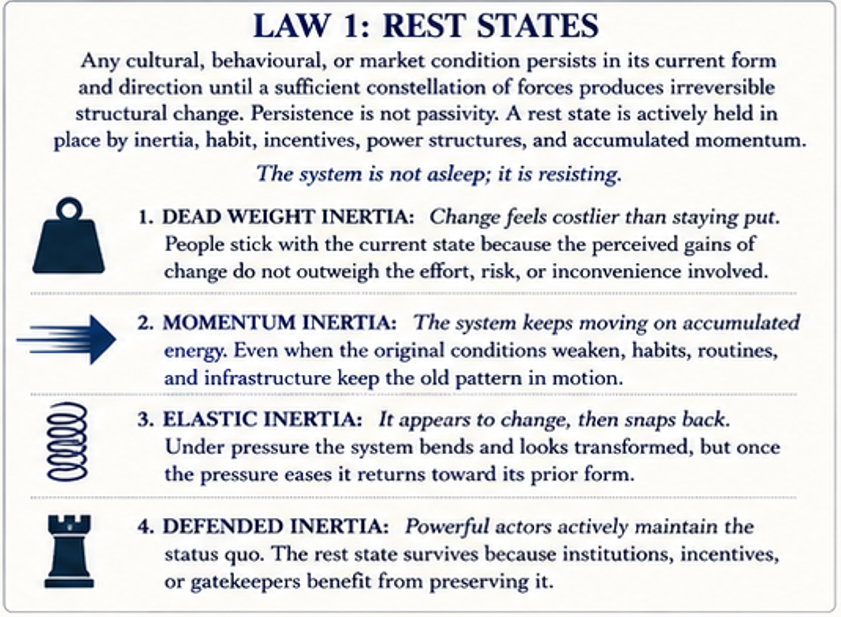
Momentum Inertia is sneakier. The system persists not because it’s resisting but because it’s already moving fast enough to carry itself forward on its own energy. Fast fashion. The office before 2020. The 30-second television spot in media planning long after the audience stopped watching television the way media planners imagined. The energy in the system outlasts the conditions that created it.
Elastic Inertia is what most people misread as structural change. The system deforms under pressure. Appears to change. And then, the moment the pressure lifts, snaps back toward its prior configuration. Not identical, but recognisably continuous. Most revolutionary change is this. Remote work. Pandemic dietary shifts. Every trend declared dead that quietly came back. The system was bending, not breaking.
Defended Inertia is the most politically significant type and the least discussed. It persists because someone powerful needs it to persist and is actively maintaining it. Algorithmic homogenisation is defended inertia. The agency holding company model is defended inertia. Fossil fuel consumption. Pharmaceutical pricing. The rest state here is not an accident or a habit. It is a product. Someone is manufacturing the status quo and billing for it.
The Second Law. The Law of Force Constellations.
No single force changes a rest state. No single force. Ever.
Change requires a constellation, multiple forces achieving simultaneous critical density, where each alone would be insufficient. Force events are triggers, not causes. The cause is always systemic, always distributed, always assembled over time in the dark before the visible moment of ignition.
A front-facing camera alone doesn’t produce selfie culture. Instagram alone doesn’t. A generation with both the narcissistic permission and the aesthetic vocabulary to self-document, alone, doesn’t. All three, arriving at critical density at approximately the same moment. That’s the constellation. That’s the ignition.
Cloud infrastructure existed before 2020. Remote work software existed. Video calling existed. A workforce already psychologically primed by a decade of laptop culture existed. None of it shifted the office. The pandemic was the force event, the trigger, that ignited a constellation that had been assembling for years. Remove any single element and the inertia holds.
This is why trend forecasting that fixates on the loudest signal almost always gets the direction wrong. The loudest signal is usually the trigger. The constellation is the actual story.
Forces within a constellation come in four varieties.
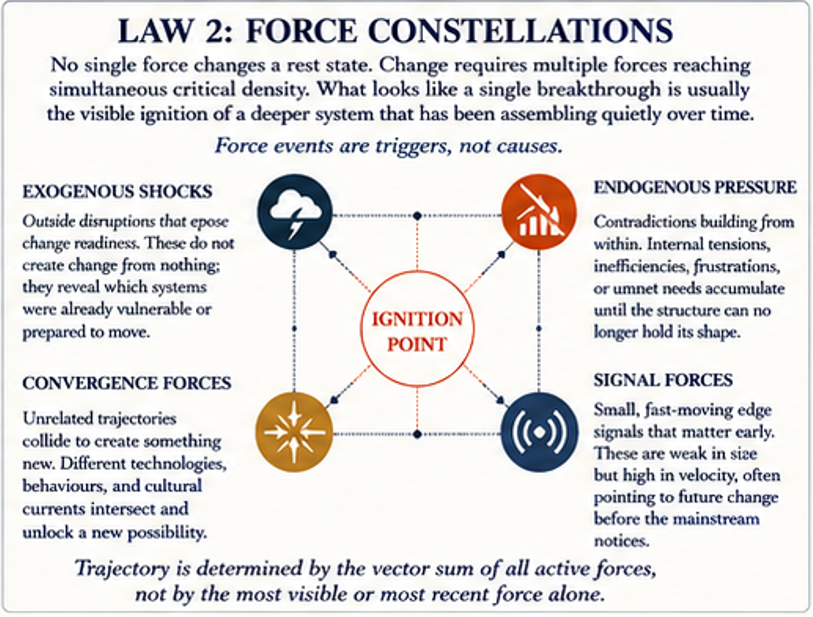
Exogenous shocks arrive from outside the system entirely. They don’t create change so much as reveal which constellations were already sitting at ignition point.
Endogenous pressure builds from within, the internal contradictions of a system accumulating until the structure can’t hold.
Convergence forces are perhaps the most generative: two entirely unrelated trajectories intersecting to produce a third thing neither predicted. Smartphones plus GPS plus social infrastructure didn’t individually point toward the attention economy. Together they built it.
Signal forces are small in mass but high in velocity. The edge case, the early adopter, the anomaly that serious analysts dismiss until it’s everywhere.
The trajectory of change, where a trend actually goes, is determined by the vector sum of all active forces. Not the most visible force. Not the most recent one. The sum.
The Third Law. The Law of Reaction Fields.
Every significant change generates a reaction. But here’s where the Newton analogy earns its complexity. Reactions are not simply equal and opposite. They occupy a field, and within that field three distinct types operate with very different strategic implications.
Mirror Reactions are the most visible. Direct reversal. Minimalism as reaction to maximalism. The dumbphone revival as reaction to smartphone saturation. Anti-consumption as reaction to hyperconsumerism. Cash as reaction to crypto. The pendulum swings back, roughly, toward where it came from. Easy to see coming if you’re watching the original trend with any diagnostic honesty.
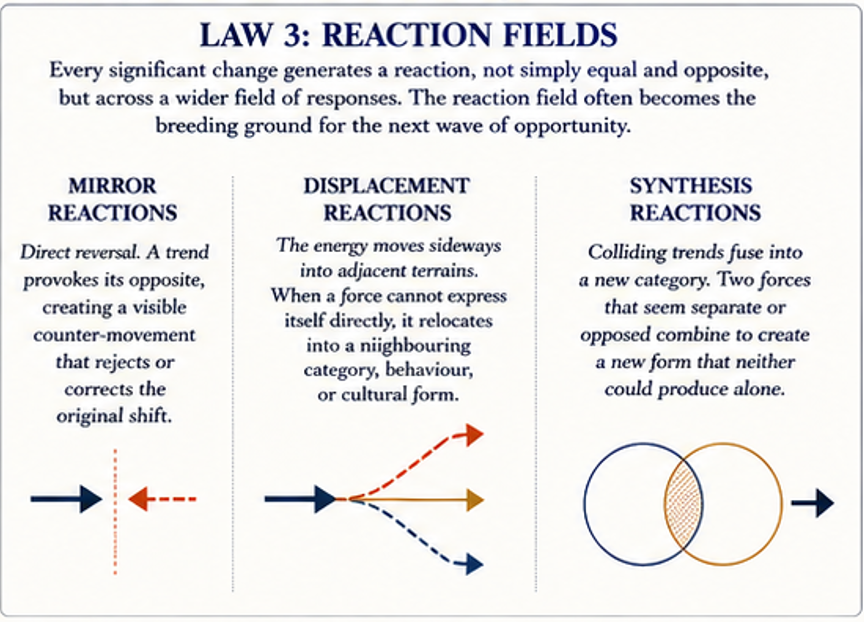
Displacement Reactions are more interesting. The force doesn’t reverse. It moves sideways into adjacent territory. When protest gets suppressed it becomes art. When art gets commodified it becomes meme. When meme gets commodified it becomes brand language. The energy doesn’t disappear. It relocates, usually somewhere the original system wasn’t watching.
Synthesis Reactions are where the real action is. Two colliding trends don’t cancel each other. They fuse into something neither predicted. Punk plus commerce produced streetwear luxury. Eastern spirituality plus Western self-optimisation produced the wellness industrial complex. These fusions create entirely new categories and they’re almost impossible to see coming unless you’re specifically watching what happens at the collision point.
The Terminology. Precisely.
Rest State. A condition in its inertial configuration. Not static. Actively resisting displacement. There’s a difference.
Force Event. The visible trigger. Always the ignition of a pre-existing constellation, never the constellation itself. The moment the system reveals what was already structurally true.
Force Constellation. The full system of forces whose combined vector sum determines whether and how a rest state actually changes. The thing nobody mentions when they tell the origin story of any trend.
Precondition Mass. The accumulated infrastructure, psychology, economics, and culture that must exist before a force event can produce structural change. The cloud computing infrastructure that had to exist before a pandemic could make remote work viable. The front-facing camera that had to be ubiquitous before Instagram could produce selfie culture. The thing that was already there, patient and unannounced, waiting for its moment.
Structural Break. Permanent displacement of a rest state. Genuinely irreversible. Far rarer than we think. Far rarer than we claim.
Elastic Deformation. Apparent change that partially or fully reverses when force is removed. Far more common than we admit. Most of what gets called revolution is this. The system bent. It did not break.
Ignition Point. The moment a force constellation reaches sufficient density to move a rest state. Not the cause. The moment the cause becomes impossible to ignore.
Vector. Direction plus velocity of a trend at any given moment. Both matter. Direction without velocity is a wish. Velocity without direction is noise.
Reaction Field. The space in which counter-forces emerge following a structural break. Almost always larger and more generative than the original trend. Almost always the territory where the next generation of significant trends is quietly assembling.
Narrative Momentum. The appearance of movement. People talking about a trend, brands adopting its language, surveys confirming intent, conferences naming it as the future of everything. Narrative Momentum can exist in complete independence from actual behavioural change. It is the most dangerous diagnostic trap in trend analysis and, not coincidentally, the most profitable one for the people selling trend analysis.
What This Is Not.
It is not a prediction engine. It does not produce forecasts. Anyone selling you a forecast dressed up as structural insight is selling you Narrative Momentum. This framework improves diagnosis. It sharpens intervention. It tells you what type of rest state you’re operating against, what constellation is assembling around you, where in the reaction field the next generative territory might be.
Here is the thing that makes this framework genuinely uncomfortable to use, and therefore genuinely worth using. It keeps forcing the same question into the room regardless of how much people want to change the subject.
What type of rest state are you actually dealing with?
Because not all inertia is the same and treating it as though it will get you killed, strategically. Dead Weight Inertia persists because change costs more than it’s worth to the people living inside it. Momentum Inertia persists because the system is running on its own accumulated energy, long past the conditions that originally generated that energy. Elastic Inertia looks like change and isn’t, which is the one that fools the most intelligent people most reliably. And Defended Inertia, the most important and most under-theorised type, persists because someone with power needs it to persist and is actively, sometimes invisibly, doing the maintenance.
Algorithmic homogenisation is defended inertia. The sameness you see across brands, across content, across cultural production is not an accident of taste or a failure of imagination. It is a product. The platforms benefit from predictability. The agencies benefit from repeatable process. The procurement systems benefit from comparable quotes. The rest state of sameness is being manufactured and invoiced, quarterly, and the invoice gets paid without anyone examining what they’re actually buying.
That observation is what this entire framework was built to make possible. Not the observation itself. Anyone can see the sameness. But the diagnostic language to explain why it persists, what it would actually take to break it, and what the reaction field looks like on the other side.
The essays that follow take each law apart across thirty years of consumer behaviour, technology, media, culture, and organisational life. They will not be comfortable. The rest state rarely is, once you see what’s holding it in place.