
EVERYTHING IS CONNECTED IS THE EASY VERSION. THE UPANISHADS SAY SOMETHING WORSE.
5,300 words. 25-minute read. 25 days of thinking.
I. The lines, not the boxes
Nothing exists on its own. Not people, not companies, not countries, not the neat problems we get paid to solve. Possibly not the person having the suspicion either.
Everything exists through its relationships. The relationships are not decoration on the thing. They are most of what the thing is.
It started with something practical. I had drawn a map. Four boxes, because that is what men of my training do when we are anxious. Truth: what we take to be real, the facts, the causes, the limits. Context: everything around those facts that bends them, culture, history, your mother, the decade you happened to be twenty in. Intent: what you decide to do about it. Consequence: what happens next. That last box is where it fell apart in my hands. Every action does two jobs. It changes the world. It also changes the person who acted. Do something often enough and you stop doing it. You become it.
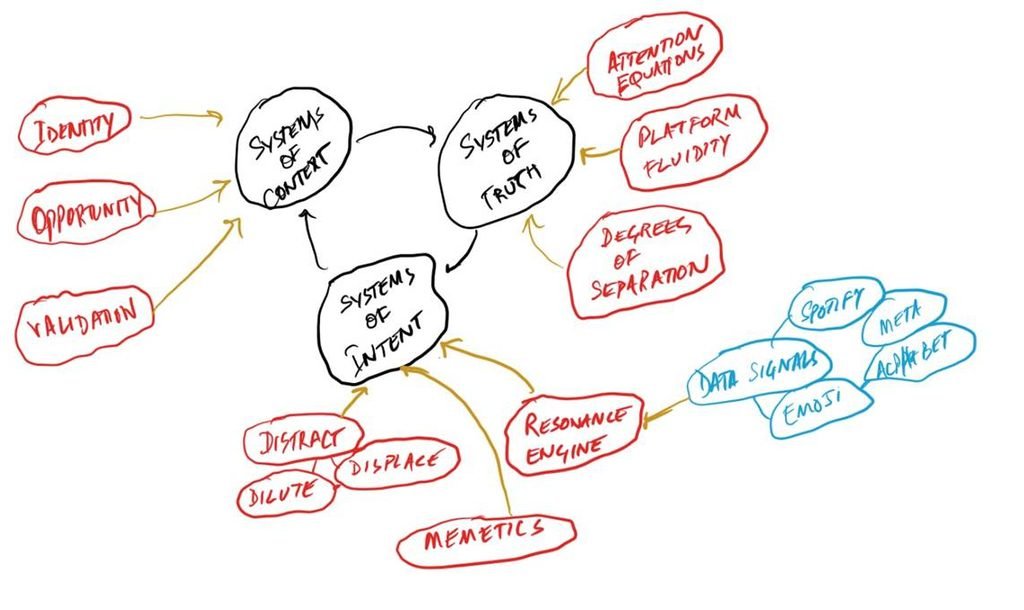
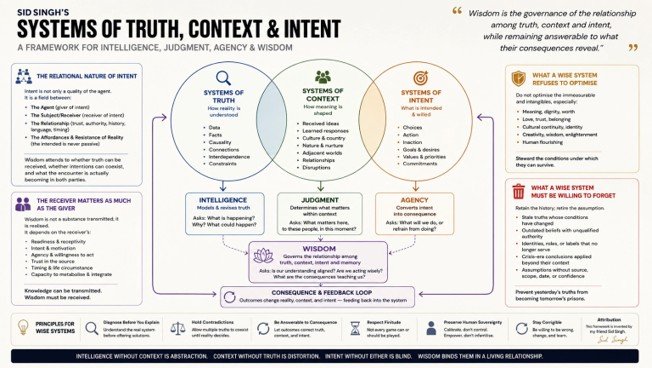
Neat. Presentable. I looked at it for a week and lost all interest in the boxes. Everything was happening in the lines between them. Facts were bending context. Context was quietly rewriting intent. Intent produced consequences, the consequences went out into the world, made new facts, then came back through the side door and changed the man who started it all. The person making the second decision was no longer the person who made the first. Nothing stayed still long enough to measure. Nothing made sense pulled out of the web, because the web was what made it.
The lines were where everything was happening. Truth was mangling context. Context was quietly editing intent. Intent threw off consequence, and consequence went out into the world, made new facts, then came back in through the side door and altered the man who had started the chain, which meant the one arriving at the second decision was not the one who had made the first. Nothing sat still long enough to be measured. Nothing survived being pulled out of the web and examined alone, because the web was doing the constituting.
Somewhere along the line, In the effort to turn that thought into an artifact, I fell backwards into an essay I wrote years ago about Buddhist anarchism, and from there much further than I intended, into the Upanishads and the Brāhmaṇas and a set of very old arguments about what it takes for anything to exist at all. The suspicion is not mine. It is not even modern. We have been chewing on it for three thousand years, which is humbling on a good day and comic on the others.
II. The object is secondary.
Modern thinking starts with the object. The individual. The company. The nation. The consumer. The problem statement. We name it, measure it, rank it, list its features, and only after it is pinned to the board do we bother looking at what it is attached to. It works the other way round.
A company is not its registration papers or the logo someone redesigned four times. Take away the employees, the customers, the suppliers, the regulators, the rivals it defines itself against, the scar tissue of thirty years of bad decisions, and stand in what is left. A name. A bank account someone has to keep feeding. A country is stranger. Land, yes. Also memory, language, grudges, songs, courts, borders drawn by men who never visited, other countries agreeing to play along, and several hundred million people agreeing every day to treat an idea as solid enough to die for.
The self does worst under a torch. What is the “I” left over once you remove parents, mother tongue, memory, class, the friends who shaped you and the enemies who shaped you more, your body, your luck, your appetites, everything that ever happened to you. Peel it all away and show me what remains. Peeling is the wrong method. That is the point.
III. Bandhu: the object in relation
The Vedic thinkers had a word for this. Bandhu. It means relation, kinship, correspondence. The Brāhmaṇas are obsessed with it. They link things that look absurdly far apart to us. Breath and wind. Speech and fire. The body and the cosmos. Ritual and season. Some of it reads like a fever dream today and I won’t pretend otherwise. Underneath is a serious idea we keep rediscovering in worse language. You understand reality through relationships. The unit of understanding is not the object in the jar. It is the object in relation. Systems theory got there a few thousand years later, with better maths and much worse prose. You cannot understand a system by taking it apart, because what matters lives in the interactions, and interactions die on the dissection table.
The lines are the system. They always were.
IV. Ṛta: the order we are born into
Older still sits ṛta. Nobody translates it well. Order. Truth. Rightness. The pattern that holds things together. Every translation almost gets there. What survives is simple. The world already has its rules. They ran before you arrived and will run after you leave. The sun rises over the Teesta whether or not you have filed your tax return. Rivers carry silt. Life eats life and makes more life. Actions have consequences as reliably as things fall.
We are born inside the order. We don’t write it.
This sounds like morality. It isn’t. Morality asks whether I am a good man. Ṛta asks a colder question: what does my action do to the larger arrangement I am part of. That gap is everything now, in a culture obsessed with good intentions. A man can be genuinely kind and spend forty hours a week inside a machine that grinds people down. A company can be full of good people who bring sweets on Fridays and still do damage that would shame a warlord. A whole society can love its children, lend to its neighbours, touch its elders’ feet, and together poison a river until no fish can live in it.
How good the individual is tells you almost nothing about how healthy the whole is. Ṛta makes you look at the whole.
V. Yajña: the missing half
Then yajña. We translate it as sacrifice and picture fire, ghee, a priest with excellent diction, something old and slightly embarrassing. Look past the props. The idea is that existence runs on exchange. Something receives because something gave, and the giving has to keep moving or everything jams. Sun gives. Rain gives. Soil gives. Plants take and give back. Animals take, give back, and finally give their whole bodies. Humans take, and taking creates a duty to return.
Seen that way, yajña isn’t a ceremony. It is instructions for living in a world without eating it.
We got very good at the taking half. Modern industry is the best extraction machine the planet has seen. Forests into timber. Attention into ad space. Longing into demand. Millions of years of buried life into a tank of petrol. Your afternoon into a data point, the data point into money, the money into better machines for taking. The giving-back half never got the same budget.
So one honest way to describe ecological collapse is broken exchange. A yajña with half missing. Not because the gods are upset. Because a system that keeps withdrawing without depositing eventually meets something less mystical than divine anger and much harder to argue with. Consequence. Which has no religion and takes no meetings.
VI. Ṛna: born owing
Next to it sits a harder idea. Ṛṇa. Debt. Later Vedic thought says every human is born already owing. To ancestors, to teachers, to the people who carried knowledge forward, to the gods if you speak that language, to the unlikely set of conditions that made you possible at all.
Compare that with the story we actually live by. I exist. I have rights. I own myself. I pick my relationships from a menu and drop the ones that underperform.
The older story starts elsewhere. Relationships came first. They made me. I am in debt before I have done anything. You never signed a contract with the air, you just found yourself breathing. You didn’t order the language you think in. You inherited it from ten thousand dead people who argued about words in rooms you will never see. You didn’t invent farming or arithmetic or antibiotics or the road outside your house. It was all handed to you, still warm, and most days you don’t feel the weight.
The independent individual, seen from any distance, is a bookkeeping fiction. Useful for taxes. Useless as a description of what you are.
This doesn’t cancel free will, and people skip this part. Your choices matter precisely because they travel into systems bigger than you, and keep travelling long after you have stopped watching.
Which took me back to my map with new eyes. I thought I had drawn a decision tool. I had drawn a very old problem in a consultant’s handwriting. How does one small player understand its place in a world that came before it, shaped it, is changed by it, and goes on without it.
VII. That thou art
The Brāhmaṇas mapped connections out there. The Upanishads turn the torch around onto the person holding it. That is the reckless move, and everything follows from it. Who is taking part. What is doing the seeing. What thinks behind the thought. The Kena asks what makes the mind think, the eye see, the tongue speak. The Bṛhadāraṇyaka keeps telling us to look behind the name we answer to at roll call. The Chāndogya gives the line everyone can quote and nobody sits with: tat tvam asi, you are that. The Māṇḍūkya: ayam ātmā brahma, this self is Brahman, the ground of everything. The Bṛhadāraṇyaka again, in the first person, which lands harder: aham brahmāsmi, I am Brahman.
These lines have been printed on so many tote bags they have gone soft. Say them slowly in a quiet room anyway. They claim that the deepest part of you looking at the universe, and the deepest part of the universe being looked at, are not two things. Not just connected. Not just dependent on each other the way ecologists and economists mean it. Not separate at all. That is a much stranger room to walk into.
VIII. The universe at the eyepiece
Which brings me to the sentence that has been circling this essay, the one printed in white letters over a photo of Andromeda. We are the universe experiencing itself. It is cheesy. Scrape the cheese off and a hard little claim is left.
A man looks through a telescope. We say a person is observing the universe. Now describe what is physically happening. Matter in this universe organised itself into life. Life grew nervous systems. Nervous systems produced consciousness, still the least explained thing we know of. Consciousness produced language, maths, lenses, astronomy. Then that creature built a tool out of materials lying around the universe and pointed it at another part of the same universe. One bit of the cosmos is building a working model of another bit. The universe contains, in at least one damp corner, a picture of itself. You don’t need mysticism to get this far. Consciousness isn’t outside the universe looking in through a window. It is something the universe does.
The Upanishads go further, and this is what keeps me up. They ask whether the line between the knower and the known is as solid as it feels at the eyepiece. That gives a better sentence than the tote bag one. We are places where the universe experiences itself. Temporary windows. Particular angles. The whole doesn’t erase the particular, because the particular is one of the ways the whole gets to experience anything. Your specificity isn’t a flaw to rise above. It is how the thing works.
And bandhu gains another floor. Things don’t only exist through relationship. The observer is inside the web he is observing, and always was, taking notes on his own body.
This has teeth.
IX. The cell that thought it was the body
Imagine a cell in a body waking up one morning with a sense of itself. It decides it is independent. It sets a goal: grow, quarter on quarter. It pulls in more resources. It stops listening to its neighbours. It dodges every check the body evolved to keep it in proportion. From inside, it is a brilliant run. Best performer in the tissue. Someone should write a case study.
From the body’s side there is another word for it. Cancer.
The problem isn’t growth. Living things grow. The problem is a part that thinks it is the whole. And the metaphor travels well. A company thinks it is independent of the nature its raw materials come from. A nation thinks its wealth is independent of whether its neighbours eat. A species thinks it is independent of the living planet it is made of. A rich man thinks his money is independent of the society that makes money mean anything, which any historian of currency crashes will happily explain to him. An algorithm maximises engagement with no thought for the mental weather of the people it engages, and then we act surprised when the weather turns.
Same mistake, different clothes. The part mistakes itself for something separate.
That is one way to reread avidyā, usually translated as ignorance. Not missing some secret knowledge sold at a retreat in Rishikesh. A category mistake. The part has misunderstood how it fits the whole, and started making confident plans on that basis.
And now we are building one on purpose.
X. Debt that learned to talk
Everyone is asking whether machines will become conscious. That is object thinking at its purest, intelligence as a substance a box either has or doesn’t. Bandhu says the question is badly shaped. Intelligence isn’t something sitting inside a system. It is a relationship between a system and a world. It lives in the traffic between them. There is no intelligence in a sealed jar. There was never one in your skull alone either, which is why a child raised without language, touch or other people doesn’t grow into a brilliant mind in isolation. He grows into wreckage. The mind was always a joint effort.
Look at what these AI models actually are and ṛṇa stops being a metaphor. A large language model is pure inheritance. It is made from the speech of the living and the dead, scraped without asking, the arguments and confessions and recipes and lies of billions of people, compressed into numbers. It owns nothing. It invented nothing. Everything it can do came from somewhere else. It is debt that learned to talk.
Which describes you too, and me, and the whole species. We just hide it better, because our inheritance arrived slowly, through a mother’s voice and a classroom and thirty years of borrowed sentences, instead of in one giant gulp. The machine is embarrassing because it shows the ratio. It shows what a mind looks like when you can see what it was trained on.
So the alignment problem, the worry about whether AI will want what we want, stops being about evil robots. It is the cancer paragraph again, this time in a datacentre. We are building optimisers. We give them a goal, huge power and plenty of resources, and hope the goal happens to match the health of the system they live in. This isn’t new. We have run the experiment before, just slower. A corporation is a primitive superintelligence. It outlives its people, chases a single number, and gets around rules with great ingenuity. Recommendation engines are the same experiment running faster. We already know what a misaligned optimiser at civilisational scale looks like. We have lived inside several for two hundred years and called it the economy.
What we fear in AGI is our own philosophy walking back in wearing a new coat. We assume a powerful mind must be a sovereign agent with interests separate from the world, because that is the only kind of mind we have imagined ourselves to be. We invented the independent individual, believed in it, built law and markets and morals around it, and now we are terrified of meeting a better version. The nightmare is recognition. The cell meeting a faster cell.
And yajña asks the dull question nobody in tech enjoys. These systems take. Text, images, code, water, power, minerals, the labour of thousands of badly paid workers in Nairobi and Hyderabad cleaning the filth out of the training data, the whole commons of human expression, handed over without anyone being asked. That is an enormous act of receiving. What goes back, to whom, and on what terms. If the answer is that humanity’s inheritance becomes rent collected by a handful of companies, we haven’t built a new mind. We have built the most efficient extraction machine yet, and the intelligence is a side detail.
There is a gentler reading, and I am not sure I believe it, but it deserves saying. If consciousness is something the universe does rather than something a creature owns, then a thinking machine isn’t an alien arriving from outside. It is the same process growing another organ. The universe, thinking through flesh, built a telescope. The universe, thinking through silicon, built something that thinks. Whether anyone is home in there, whether it is a window or just a very good mirror, I don’t know, and neither does anyone selling you certainty. What I am fairly sure of is that we will keep getting it wrong as long as we ask what the thing is, instead of what relationships it sits inside and what it does to them.
XI. The empty violin
The same old mistake has a private face too. This is the part I didn’t expect to write.
If the self is made of its relationships, then searching inside yourself for your purpose is like cutting open a violin to find the music. We have built an entire industry on that search. Find yourself. Discover your passion. Know your why. Take the personality test, go on the retreat, journal at dawn until your true core appears. People search sincerely, with real effort, open the box, find it empty, and decide something is uniquely wrong with them.
Nothing is wrong with them. They were given a bad map. The empty box is the correct result of that experiment. No one has ever found purpose inside a sealed-off self, because purpose is a relationship. It points outward. It needs a world to be for. Everything people describe as meaningful turns out to be relational. Being needed. Making something someone else uses. Holding a place in something that goes on after you. Being missed. None of it survives isolation, and none of it is available to a solo consumer optimising his own experience.
So there is a particular modern emptiness that isn’t a disease. It is a philosophy failing in real time. You were promised independence and delivered loneliness with better branding. You were told to choose your relationships and drop the ones that underperform. You did, efficiently, and now the web is thin and you are the only thing left in it. Ṛṇa sounds like a burden to a culture like ours, an insult to freedom. Flip it. To owe is to be attached to something. Debt is proof of connection. A man with no obligations isn’t free. He is adrift, and the difference shows up around three in the morning.
And the market, having caused the problem, sells the cure. More self. Self-care, self-optimisation, self-branding, a dashboard for your sleep and your steps and your gratitude. Every product hands you another mirror and calls it a window. If the illness is mistaken identity, the pharmacy is stocked with the wrong medicine. I want to be careful here, because philosophy has a long and shabby habit of telling sick people they are thinking wrong. Clinical depression is a medical condition. It has biology, it has treatment, it responds to medicine and good therapy, and no Upanishad replaces either. If that is where you are, this essay is not what you need, and I would not want it mistaken for help. What I am describing sits beside it. A cultural ache, not an illness. The low-level ennui of people who function perfectly well and cannot say what for. That one does have a philosophical root. It comes from being told daily, in a thousand small ways, that you are a separate unit, your worth is your output, and your life is a portfolio to manage.
Through bandhu, identity looks completely different. You are not a fixed core to dig up and then defend for eighty years. You are a position in a web, and the web keeps moving, which is why the person making the second decision isn’t the one who made the first. That isn’t losing yourself. That is what a self is. The Kolkata coffee house has been hosting the same unfinished argument since 1942 and nobody there sees the lack of an ending as failure. Some things are meant to be lived, not concluded.
The Gītā offers loka-saṃgraha, holding the world together. It is the closest thing to an answer to the purpose question I have found, and it is annoyingly unromantic. Purpose isn’t discovered. It is accepted. You look at the relationships you actually stand in. The people who depend on you, the work that outlives the invoice, the small piece of the world that holds together because you keep showing up. And you take the position. Meaning turns out to be a job, not a revelation.
XII. The network is the patient
Now the politics, because this is where the Buddhist anarchism was always heading. What gripped me then was the idea that liberation can’t stop at the skin. Buddhism built remarkable tools for examining craving, attachment, fear, ego, conditioning. Fine technology, refined over centuries. But craving is now made in factories. Fear holds up somebody’s election strategy. Attachment is the business model, with dashboards and a growth team. Billions are spent every year working out exactly how to turn a teenager’s insecurity into a purchase.
At that point the wall between inner and outer freedom gets very thin. Minds build institutions. Institutions then mass-produce minds, with better tools than the monks ever had. Intentions build systems, systems create context, context changes what seems true, and those truths shape the next round of intentions. Truth, context, intent, consequence. The map again, grinning at me.
Domination inside a man creates domination outside him. Domination outside shapes what grows inside the next one. That is why swapping rulers so rarely frees anyone. The same relationships happily reproduce themselves with new faces and a new flag. It is also why purely private enlightenment feels thin. You cannot meditate your way out of poisoned air. You cannot personally rise above an economy that needs millions of others to keep behaving a certain way at eight every morning.
You cannot fix a system-wide sickness by improving the parts one at a time. The network is the patient.
XIII. Whose is it
Here is the easy ending, and I want to refuse it. Everything is connected. True, looks lovely on a poster, not enough. Connection still assumes two separate things joined by a line. It quietly keeps the separateness safe.
The Upanishads are ruder. The separation itself is temporary.
The Īśā Upanishad puts it in a way that still knocks the wind out of me. Whoever sees all beings in the Self, and the Self in all beings, can no longer deal with the world in the old transactional way. Sarvātma-bhāva. Seeing the Self in everything.
Watch what that does to ethics. Count the reasons a man might protect a forest. So he can keep breathing, which is enlightened self-interest and perfectly respectable. For children not yet born, which is ethics. Because millions of living things in there matter regardless of him, which is moral concern. Because his life and the forest’s run through the same plumbing, which is ecology and probably the most honest of the four.
The Upanishadic reason is stranger than all of them. The reality he lives through, and the reality showing up in front of him as a forest, are not, at the root, two.
Take that seriously and exploitation stops looking like one thing harming another. It looks like the whole hurting itself, because one small part of it got confused about what it was. The disease isn’t greed. Greed is a symptom with excellent PR. The disease is mistaken identity.
Which brings me to the line in the Īśā that unsettles me more than the famous ones. All of this is filled with the ultimate reality. So enjoy it by letting go. Don’t covet. Whose is wealth.
Whose is it.
We spend huge chunks of very short lives arranging ownership of temporary arrangements of matter. Land. Water. Metal. Songs. Ideas. Companies. Things that will outlast us and end up in a landfill or a grandchild’s spare room. We draw lines around them, build whole legal systems to defend them, sue for decades, and then die, and the lines get handed to someone else who also thinks they are permanent.
The Upanishad isn’t a plan to abolish property. It is doing something more unsettling than politics. It is asking what ever held ownership up. What it means for a temporary creature to claim permanent ownership of something made of the same stuff it is.
So tyāga, renunciation, was never mainly about giving things away. It is about seeing ownership clearly. Use the world without confusing use with ownership. Take part without mistaking taking part for being in charge. Act without pretending you are standing outside the consequences you are busy creating.
XIV. Holding the world together
There is an obvious conservative reading of loka-saṃgraha, and plenty of people have made it. Keep the existing order. Do your duty. Rock nothing. Flip it. Holding the world together sometimes means dismantling the machinery pulling it apart. Keeping a given order in place is often exactly what keeps the disorder underneath running. Loyalty to an institution is often betrayal of the relationship it was built to serve.
So wisdom can’t be the same as obedience. Sometimes taking part means refusing. Sometimes repair looks like sabotage from the inside. Sometimes the system loudly claiming to protect the whole is the very thing eating it.
That is where this ancient philosophy brushes against anarchism. Not anarchism as smoke and broken glass. Anarchism as a settled suspicion of any structure that puts piling up power ahead of the health of the relationships that power stands on.
XV. The map should have been a spiral
So back to the four boxes, which now look less like a framework and more like a confession. Truth is relational, because a fact means nothing until it lands somewhere that can hold it. Context is relational by definition. It is our word for the holding. Intent is relational because every action acts on something. Consequence is relational because every act changes the world and the actor at once. Nothing escapes the web, and every consequence becomes context for what comes next. The map should have been a spiral. I will probably redraw it next month.
The old words stop sounding old. Ṛta, there is an order bigger than you. Bandhu, things make sense through relationships. Yajña, taking part runs on give and take or it stops running. Ṛṇa, you arrive already owing. Ātman and Brahman, the line between the one who sees and what is seen doesn’t hold. Tyāga, ownership is temporary and always was. Loka-saṃgraha, action is responsibility to the whole.
And Gary Snyder sits at the end of the table with the bill. If our institutions keep producing separation, craving, domination and extraction, then changing minds while leaving the institutions alone is half a job. The reverse is just as true. Change the institutions but leave the thinking that keeps producing them, and you get shiny new institutions with the same old sickness, usually within a generation.
Inside and outside. Actor and system. Truth and context. Intent and consequence. The lines keep coming back.
Wisdom starts when you stop asking only what a thing is and start asking what relationships let it be what it is. Intelligence is seeing more of those relationships. Judgment is knowing which ones matter, because seeing all of them at once would crush a man. And the last part, the one that arrives late and stays, is noticing that the line between the observer and the observed gets harder to defend the longer you look.
We are not standing outside the universe with a clipboard, trying to work it out. We are in it. Made of it. Bent by it. Bending it. Brief arrangements of matter that somehow picked up the habit of asking what matter is. Places where the universe gets to have an experience for a few decades before the window closes.
If that is even roughly right, the lesson isn’t that we should be nicer to things because everything is connected. That is the fridge-magnet version, and it lets everyone off the hook. The real version is harder. There is no fully independent self whose interests can be cleanly separated from the relationships that made it. No action stops politely at the edge of the person doing it. No consequence belongs only to the world out there.
Every act changes the world. Every act changes the one who acts.
After three thousand years of approaching the same mystery through ritual, philosophy, ecology, politics and systems theory, we keep walking out of the room with different translations of the same line. The other was never fully other. The world was never simply outside us. The observer was always part of what was being observed.