
A source-backed draft, stitched together from an old thought piece on Total Experience Systems, an academic paper on the relationship between experience and equity (Brakus et al. 2009) and the CX trends for 2026 . Same bones. Grittier blood.
WORKING THESIS, NO CHASER.
The industry still runs marketing like a filing cabinet, channels here, functions there, everybody guarding their own drawer. Consumers don’t experience any of that. They experience a system, whole and messy and indifferent to your org chart. The Total Experience System hands you the operating model for that mess: build the right affective charge, the right intellectual clarity, the right behavioural nudge, across screens, shelves, packs, products, services and occasions, then wire every single one of those encounters back to brand equity, purchase behaviour and growth. Brakus and company give you the ruler to measure it with. CX 2026 gives you the deadline. AI, agentic commerce, data debt piling up like unpaid rent. Coherence isn’t a nice-to-have anymore. It’s survival.
Somewhere along the way, marketing lost the plot. Not completely. Not irreversibly. But enough. Marketing became the campaign. Creative became the idea. Media became the plan. CX became the service layer. Data became the dashboard. Digital became whatever the app team, CRM team or performance team happened to own. Each function built its own language, scorecard and mythology. The consumer, predictably, never signed up for any of this.
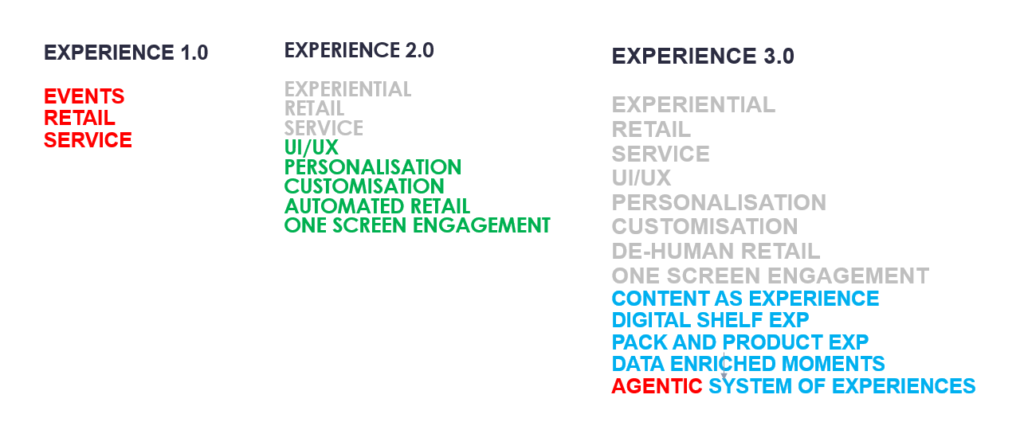
No human being experiences a brand as a channel plan. Nobody says, I had a strong upper-funnel exposure, followed by mid-funnel consideration, followed by a lower-funnel conversion event. People experience brands as a sequence of encounters: a glance, a search, a review, a recommendation, a pack on a shelf, a line in an ad, a delivery delay, a refund refusal, a chatbot that either helps or humiliates them, a product that feels right, a price that feels fair, a promise that survives contact with reality.
That is the system. And that is why CX is no longer a department. CX is the connective tissue of growth.
The Total Experience System starts with a sharper premise than most CX talk. The role of brand communications is to generate desired consumer response. That response depends on the purchase decision journey and the strength or weakness of brand equity. But the response at any brand encounter is driven by the experience the brand generates. The brand does not create growth by merely being visible. It creates growth by generating the right kind of experience in the right kind of moment, then making that experience repeatable across the system.
The Total Experience System as the spine
| “There are 4 places these experiences may happen: Screens, Shelves, Package/Product, Occasions.” |
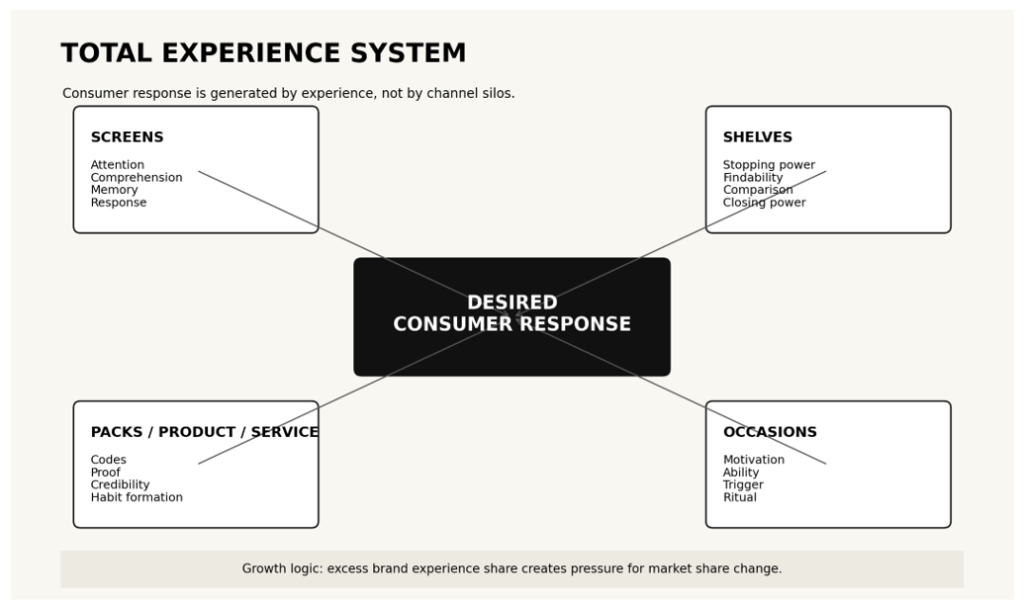
Total Experience Systems starts with a deceptively simple chain of causality. Brand communications exist to generate a desired consumer response. That response is shaped by the purchase decision journey and by the brand equity problem being solved. At any encounter, the response is driven by the experience the brand generates. This moves the planner away from channel-first thinking and toward experience design.
The four surfaces are the operating layer. Screens are not merely media inventory; they include lean-back film, lean-forward search, byte-sized social formats, conversational interfaces and algorithmic surfaces. Shelves are not merely retail; they compress choice and must create stopping power, findability, confidence and closing power. Packs, products and services are not executional leftovers; they carry sensory codes, credibility, reason-to-believe and habit formation. Occasions are where the brand earns repeat behaviour; motivation, ability and trigger decide whether the brand becomes ritual or noise.
Operating surfaces and strategic jobs
| Surface | Consumer posture | Strategic job | Growth question |
| Screens | Watching, searching, scrolling, asking | Attention, memory, comprehension, response | Did the encounter move people closer to the desired response? |
| Shelves | Choosing under pressure | Stopping power, findability, comparison confidence, closing power | Did the brand win the moment of compression? |
| Packs / Product / Service | Handling, using, evaluating, resolving | Codes, proof, credibility, habit formation | Did the proof match the promise? |
| Occasions | Living, repeating, sharing | Motivation, ability, trigger, ritual | Did the brand attach to a real behaviour? |
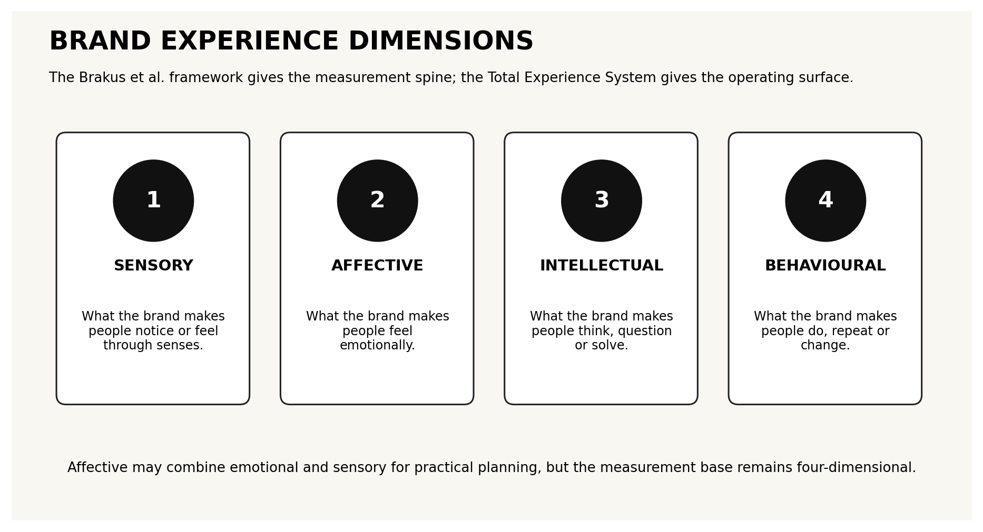
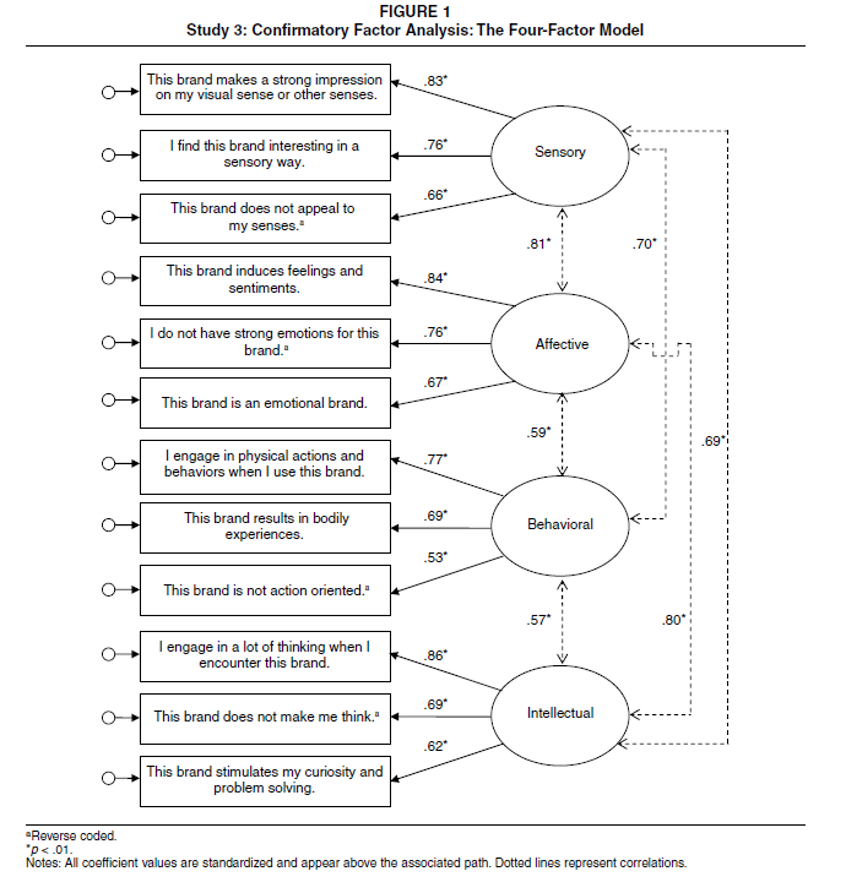
There are three practical experience types to manage: affective, intellectual and behavioural. Affective covers what people sense and feel. Intellectual covers what people think, understand, question or solve. Behavioural covers what people do, repeat, avoid or change. These are not decorative labels. They are planning instruments. If the brand equity weakness is salience, the experience job may be affective and sensory. If the barrier is trust or complexity, the job may be intellectual. If the business needs trial, usage, upgrade or retention, the job becomes behavioural.
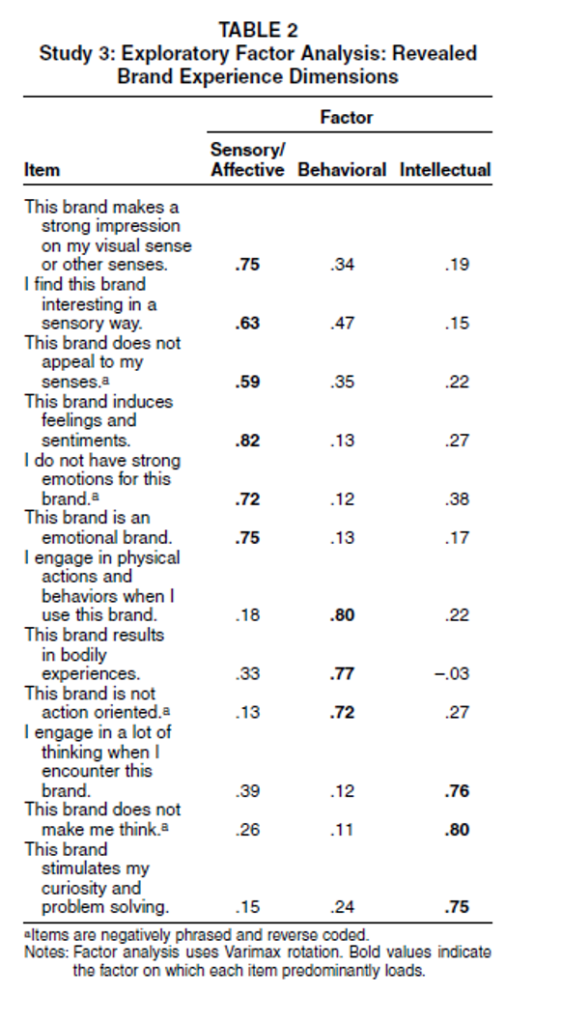
The 2009 Brakus, Schmitt and Zarantonello paper gives this argument its measurement spine. It defines brand experience as sensations, feelings, cognitions and behavioural responses evoked by brand-related stimuli across design, identity, packaging, communications and environments. Crucially, it separates experience from liking, involvement, attachment, delight and personality. Experience is not simply whether someone has a positive view of the brand. It is what the brand makes them sense, feel, think and do.
“Brand experience is conceptualized as sensations, feelings, cognitions, and behavioral responses evoked by brand-related stimuli.” Brakus, Schmitt and Zarantonello, Journal of Marketing, 2009
The 2009 paper is useful because it prevents experience from becoming another vague word. It separates brand experience from attitude, involvement, attachment, delight and personality. In other words, experience is not just whether people like the brand; it is what the brand makes people sense, feel, think and do. This maps neatly into the Total Experience System. Brakus gives the dimensions; the Total Experience System gives the places where those dimensions must be designed and measured.
For a blogpost, this is the intellectual anchor. The argument does not need to sound academic, but the academic foundation gives it weight. A brand experience is not a mood board. It is a measurable set of responses generated by specific stimuli across identity, packaging, communications and environments. That is exactly why CX cannot be isolated to service. Service is only one place where the brand is experienced.The Total Experience System turns that academic foundation into an operating model. It says these experiences happen across four surfaces: screens, shelves, packs or products or services, and occasions. Screens are not just media. A lean-back film, a lean-forward search result, a product detail page, a conversational assistant and a TikTok loop create different postures in the consumer. They carry different levels of effort, memory and intent. To call all of them digital touchpoints is to hide the work they actually do.
Shelves are not just retail. They are decision compression environments. Physical shelves, digital shelves, marketplace shelves, search shelves, app shelves and now AI-agent shelves all force the brand to become legible under pressure. The job is not visibility in the lazy media sense. The job is stopping power, findability, comparison confidence and closing power. A brand that looks distinctive in a manifesto but generic on Amazon, Noon, Talabat or an operator app has not solved anything.
Packs, products and services are not downstream execution. They are proof systems. Shape, size, material, claim, interface, service script, refund rule, delivery promise, onboarding screen and usage cue either reinforce the brand or expose the lie. The pack is often the last advertisement before purchase and the first evidence after purchase. The service interaction is often the moment where the brand’s values are either operational or imaginary.
Occasions are where brands become behaviours. This is where the language of moments usually becomes too soft. An occasion is not a planner’s poetic flourish. It is the live intersection of motivation, ability and trigger. If a brand cannot attach itself to a repeatable occasion, it remains dependent on paid reminders. If it can, it becomes easier to buy, easier to use, easier to remember and easier to defend.
This is why the old separation is breaking down. Marketing is not art because the job is not self-expression. Creative is not marketing because the idea has to survive media, price, product, service, data and delivery. Media is not optional because there is no brand experience without distribution, sequencing, context and repetition. CX is not customer support because the experience begins long before the complaint and continues long after the purchase.
The more fragmented the world becomes, the more integrated the experience has to feel. And now AI has made this brutally urgent.
CX IN 2026. AI, AI EVERYWHERE
The CX 2026 landscape is not about making existing touchpoints slightly smoother. It is moving from digital hygiene to agentic autonomy. Autonomous systems will increasingly compare, recommend, negotiate and transact on behalf of consumers and brands. In that world, your brand is not only being interpreted by people. It is being interpreted by systems. If your data is inconsistent, you disappear. If your claims are unclear, you get misrepresented. If your service policies contradict your pricing engine, your own infrastructure manufactures mistrust.
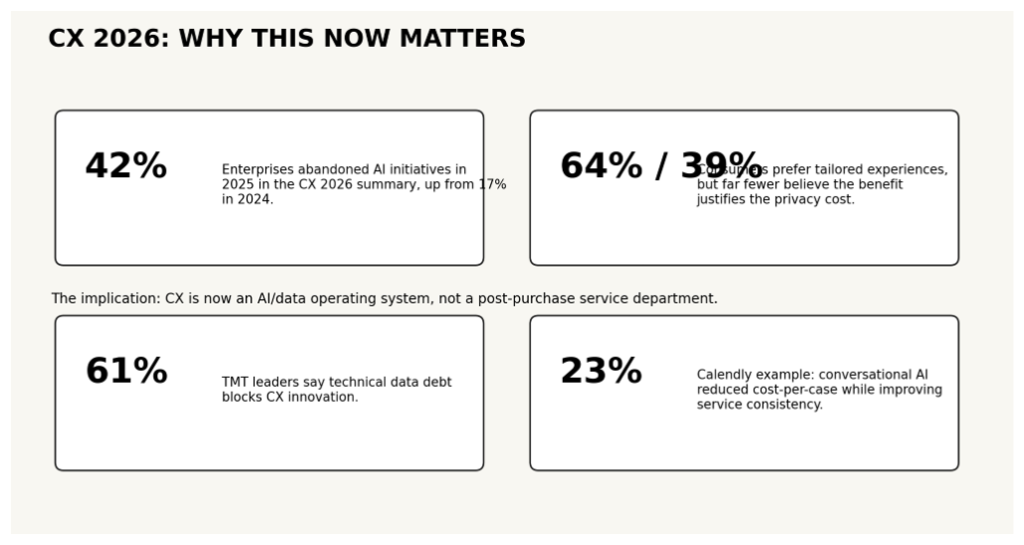
This is the new version of brand incoherence: agent debt. The risk is not that a chatbot gives a bad answer once. The risk is that isolated agents, disconnected data and ungoverned automation start making conflicting decisions at machine speed. A sales agent offers one thing. A billing agent refuses it. A service agent apologises without authority. A pricing model protects margin while a retention model destroys trust. The machine is efficient. The experience is incoherent. The brand pays the bill.
The 2026 shift is not merely more digital. It is the move from digital hygiene to agentic autonomy. CX 2026 describes a world in which autonomous systems make real-time decisions, negotiate and transact on behalf of brands and consumers. In that world, experience failures scale faster. If product data is inconsistent, the brand disappears from agentic consideration. If service policies contradict pricing logic, the brand trains machines to create customer distrust. If generative interfaces speak in generic corporate language, the brand becomes invisible while pretending to be efficient.
This is why Total Experience Systems needs a 2026 update. The original model already understood connected experiences, digital shelf, content as experience and data-enriched moments. CX 2026 adds the new operating risks: agent debt, data debt, explainability, registry, orchestration and privacy-personalization tension. The old problem was fragmented marketing. The new problem is fragmented autonomy.
The answer is not to romanticise humans and reject automation. The answer is to encode the experience system properly. Data needs standardisation. Agents need orchestration. Prompts, models and decisions need a registry. Decisions need explainability. But all of this must be tied back to the brand’s desired consumer response. Otherwise AI becomes a faster way to produce sameness, confusion and leakage.
The new question is not, what is the campaign idea? The new question is, what is the experience system? What should people feel, think and do at each encounter? Which equity weakness is this moment supposed to strengthen? Which journey friction is this moment supposed to remove? Which memory structure is this moment supposed to build? Which behaviour is this moment supposed to make easier? Which data signal should this moment generate? Which human judgement should remain protected from automation?
That is where CX becomes the glue. Not because CX people are nicer. Not because empathy is suddenly fashionable. Not because journey maps look good in workshops. CX is the glue because it forces the organisation to confront the consumer’s actual continuity. The consumer does not care which department owns the breakdown. They only know the brand broke.
A brand promise that does not reach service is theatre. A media plan that ignores availability is waste. A beautiful app that cannot resolve a billing issue is decoration. A loyalty programme that requires effort without meaning is bribery. A personalisation engine without consent and trust is surveillance. A chatbot without escalation is a locked door wearing a smile.
The next phase of marketing will belong to companies that manage experience as a growth system. That means measuring more than impressions, clicks and NPS. It means understanding experience share against market share. It means planning across screens, shelves, packs and occasions rather than handing the consumer from one silo to another. It means treating digital shelf optimisation, reviews, product data, service scripts, content formats, retail codes and AI agents as parts of one commercial architecture.
The strongest brands will not be the ones with the best ads, the slickest apps, the cheapest media, the most aggressive personalisation or the fastest bots. They will be the ones whose every encounter adds up to something coherent. Sensory, affective, intellectual, behavioural. Human-readable and machine-readable. Distinctive in communication, reliable in service, credible in product, consistent in data, alive in culture.
Marketing is not art. Creative is not marketing. Media is not optional. CX is not customer support. The brand is the experience system. Growth belongs to whoever can make the system hold.
Receipts, for the record: Total Experience Systems 1.0.pptx (Me, Sid); Brakus, Schmitt and Zarantonello, Brand Experience: What Is It? How Is It Measured? Does It Affect Loyalty?, Journal of Marketing, 2009; CX 2026 Trend Analysis conducted by me.